Colette Baron, of ‘Save Kincumber Wetlands’ and Coast Environmental Alliance (CEA) embodies a distinct configuration of conspirituality as outlined by Ward and Voas (2011) and elaborated by Halafoff et al. (2022): she fuses New Age spiritual beliefs, natural wellness practices, and community activism within a matrix that resists scientific authority, institutional legitimacy, and Indigenous governance.
Her presence across alternative health networks and environmental protest movements on the NSW Central Coast places her at the intersection of what can be termed interconnected realities; belief systems that appear benign or benevolent but which, upon deeper analysis, manifest features of cultic logic, conspiratorial thought, and settler ideation.
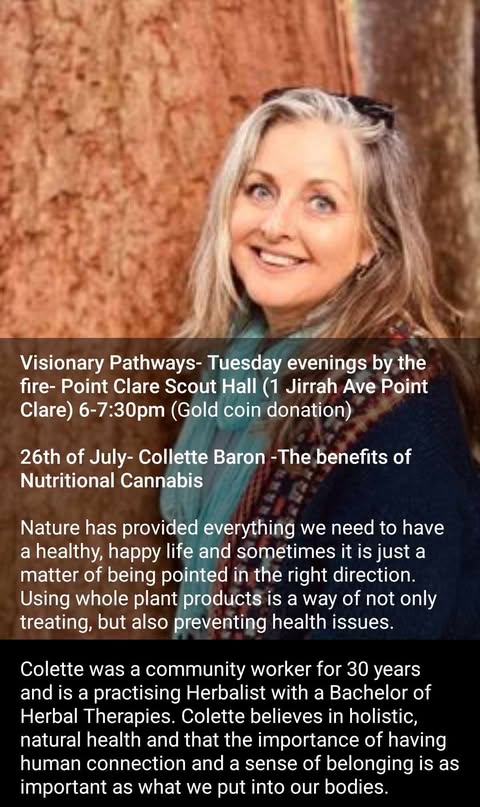
1. Magical Thinking and Natural Lore Wellness
Baron’s Mother’s Medicine brand is built on a synthesis of formal herbal medicine training and intuitive spiritual practice, claiming to treat ailments through bush flower essences, energy healing, and “nutritional cannabis” (The Portal of Life, 2022).
This aligns with what Fetterman et al. (2019) describe as paranoia-tinged alternative health systems, where the rejection of biomedical norms coexists with esoteric explanatory frameworks. Her association with the Church of Ubuntu—a group that rejected COVID vaccination and was embroiled in a child endangerment controversy—exemplifies what Goldacre (2014) and Kalpokas (2019) identify as post-truth pseudomedical epistemology.
This framing of herbalism as “lore” or “medicine woman” knowledge mirrors what Breslin and Lewis (2015) link to magical thinking in therapeutic culture: health becomes spiritual destiny, disease a misalignment of energetic forces.

Colette Baron’s invocations of “earth wisdom,” “primal knowing,” and “walking the journey” reflect not only a spiritual worldview but a disavowal of empirical authority, consistent with the magical-realist orientation of cultic health communities (Langone, 1993; Lalich, 2004).
2. Cultic Dynamics and Coercive Ecologies
The Church of Ubuntu—within which Baron holds certification as a “Natural Lore Cannabis Practitioner”—displays several cultic markers as identified in the ICSA manuals and Lalich and McLaren’s (2018) concept of bounded choice. These include ideological purity tests, a charismatic leadership, group-based health narratives, and distrust of external authority (ABC News, 2024; Chait v. Church of Ubuntu, 2022).

While Baron may not occupy a leadership position, her continued public identification with the Ubuntu network suggests a form of cultic adjacent legitimacy, where credibility is conferred through affiliation with anti-system, closed-world belief systems (Cooke, 2025; Crabtree et al., 2020).

Her holistic marketing language mirrors the kind of mystical commodification and affective entrainment described by Muirhead et al. (2023) in their work on ecofascist spiritual branding. In this respect, Colette Baron participates in what Day and Carlson (2023) call weaponised spiritualism: the use of seemingly therapeutic language to encode resistance to modernity, governance, and collective science.
3. Settler Mimicry and Environmental Paternalism
Baron’s activism in Save Kincumber Wetlands, Coast Environmental Alliance, and Community Voice Australia presents a clear case of settler environmentalism colliding with Aboriginal self-determination. Her public opposition to the Darkinjung Local Aboriginal Land Council’s proposed development of Kincumber land illustrates the pattern described by Moreton-Robinson (2015) as white possessive logic: the land is valued not for its role in Aboriginal sovereignty, but for its utility in serving the white environmental imaginary.
While she and others often invoked Aboriginal heritage in their rhetoric, these invocations occurred without community endorsement or cultural legitimacy from Aboriginal authorities such as DLALC. This is a form of what Deloria (1998) and Watego (2021) would describe as Indigenous simulacra—a performative engagement with Indigeneity that displaces real cultural authority. She and her associates thus enact a form of settler mimicry, claiming to speak for Country while functionally obstructing Indigenous-led economic development and cultural governance (Guringai.org, 2025a; 2025b).
This settler spiritual authority is also reflected in the GuriNgai-linked pseudocustodianship that circulates around CEA and related movements (Cooke, 2025). Though Baron has not claimed Aboriginal identity herself, her proximity to such actors and her deployment of “earth mother” archetypes positions her within the broader phenomenon of Pretendian-adjacent cultural co-option.
4. Epistemic Mistrust and Conspiratorial Enmeshment
Baron’s activism is enmeshed in a broader digital and ideological ecosystem of conspirituality, anti-government sentiment, and institutional mistrust. Community Voice Australia (Central Coast), with which Baron has aligned, is a convergence point for activists opposed to government development, vaccine mandates, and mainstream climate policy (Guringai.org, 2025b; Hardy, 2023). This reflects what Williams et al. (2025) term the monological belief system, wherein disparate conspiratorial ideas are woven into a single worldview of elite control and righteous resistance.
Her presence in forums populated by anti-vax, eco-anarchist, and New Age conspiracy thinkers situates her not as an outlier but as a nodal figure in the epistemic drift away from consensus reality (Van Prooijen et al., 2017; Renner et al., 2023). This is compounded by the use of emotionally charged narratives that create what Salter (2012) calls a symbolic moral economy of emergency, where urgency justifies epistemic closure.
Conclusion: Baron as a Mediator of the New Settler Conspirituality
Through the analytical lens developed in Interconnected Realities, Colette Baron can be seen not merely as a wellness practitioner or activist but as a cultural node in a wider landscape of spiritualised resistance, pseudoscientific health belief, and settler reenchantment. Her role exemplifies the fusion of maternal healing archetypes, digital counterculture, and ecological romanticism that fuels the contemporary wellness-conspiracy-environmentalist complex. While she likely perceives herself as defending nature and community, the epistemological and political effects of her work contribute to epistemic mistrust, cultural displacement, and the reproduction of settler moral authority.
If left unexamined, such figures and networks risk becoming soft conduits for harder conspiratorial ideologies, posing significant challenges to public health, Aboriginal governance, and democratic environmental policy. Baron thus offers a potent case study for how well-intentioned activism can become co-opted by the deeper architectures of cultic belief, settler mimicry, and magical thinking.
References
ABC News. (2024, March 21). Church of Ubuntu loses unfair dismissal case after sacking COVID-vaccinated Byron Bay woman. https://www.abc.net.au/news/2024-03-21/church-of-ubuntu-loses-vaccination-dismissal-case/103608482
Cooke, J. D. (2025). The GuriNgai cult: Settler conspirituality, digital identity fraud, and cultic structures on the Central Coast of NSW. bungaree.org and guringai.org.
Crabtree, J., Ferretti, F., & Renner, S. (2020). Cults of personality: The dictator’s dilemma and preference falsification in authoritarian regimes. Cultic Studies Journal, 36(2), 105–129.
Day, M., & Carlson, B. (2023). Conspirituality and the weaponisation of Indigenous identity. In M. Maddison & A. Watego (Eds.), Indigenous sovereignty and the politics of truth (pp. 145–167). Sydney University Press.
Deloria, P. J. (1998). Playing Indian. Yale University Press.
Fetterman, A. K., Robinson, M. D., & Meier, B. P. (2019). The power of metaphors: Examining the impact of metaphorical language on health decision-making. Social and Personality Psychology Compass, 13(6), e12471.
Guringai.org. (2025a, June 14). Save Kincumber Wetlands, Coast Environmental Alliance, and the denial of Aboriginal sovereignty – A long con, gone on too long. https://guringai.org/2025/06/14/save-kincumber-wetlands-coast-environmental-alliance-and-the-denial-of-aboriginal-sovereignty/
Guringai.org. (2025b, March 31). Lisa Bellamy to run as an Independent for Robertson. https://guringai.org/2025/03/31/lisa-bellamy-running-for-robertson-in-2025/
Goldacre, B. (2014). Bad science. Harper Perennial.
Hardy, K. (2023). Sovereign citizens in Australia: Pseudolaw, disruption and threat assessment. Australian Journal of Law and Society, 28(2), 89–105.
Halafoff, A., Rocha, C., Weng, A., & Roginski, C. (2022). Contemporary conspirituality: Gender, immortality, meme culture. In J. Crabtree et al. (Eds.), Contemporary conspirituality (pp. 10–43). Routledge.
Kalpokas, I. (2019). A political theory of post-truth. Palgrave Macmillan.
Lalich, J., & McLaren, B. (2018). Escaping utopia: Growing up in a cult, getting out, and starting over. Hachette Books.
Langone, M. D. (Ed.). (1993). Recovery from cults: Help for victims of psychological and spiritual abuse. W. W. Norton & Company.
Moreton-Robinson, A. (2015). The white possessive: Property, power, and Indigenous sovereignty. University of Minnesota Press.
Muirhead, J., Jasmin, C., & Duffy, L. (2023). Ecofascism in digital space: Far-right environmental rhetoric and online radicalisation. Journal of Environmental Sociology, 9(1), 45–69.
Renner, S., Gusterson, H., & Crabtree, J. (2023). Apocalyptic manhood and doomsday prepping: Gender and survivalist fantasy in the digital age. In Contemporary Conspirituality. Routledge.
Salter, M. (2012). Organised abuse and the politics of disbelief. Journal of Child Abuse & Neglect, 36(8), 618–629.
The Portal of Life. (2022). Colette Baron – Mothers Medicine (Practitioner profile). https://theportal.life/mothers-medicine
Van Prooijen, J. W., Douglas, K. M., & De Inocencio, C. (2017). Connecting the dots: Illusory pattern perception predicts belief in conspiracies and the supernatural. European Journal of Social Psychology, 48(3), 320–355.
Ward, C., & Voas, D. (2011). The emergence of conspirituality. Journal of Contemporary Religion, 26(1), 103–119.
Watego, C. (2021). Another day in the colony. University of Queensland Press.
Williams, R. D., Hassan, R., & Galbraith, L. (2025). The monological belief system and democratic fragility: Epistemic closure in online political communities. Journal of Cognitive and Political Studies, 14(1), 58–82.
 Bungaree.org
Leave a comment