Abstract
This report provides a comprehensive forensic investigation into the false Aboriginal identity claims made by Charlie Woods, the frontwoman of the musical act Charlie Needs Braces. The analysis confirms that Charlie Woods is not Aboriginal, having no genealogical, cultural, or community connection to the Central Coast, Northern Sydney, the historical Guringai, or the Aboriginal family of Bungaree and Matora.

Particular attention is paid to the group’s co-option of the discredited “GuriNgai” ethnonym and its association with settler cultic networks including the Coast Environmental Alliance (CEA). The report finds that Charlie Needs Braces perpetuates a curated and monetised simulation of Aboriginality, which constitutes a form of strategic cultural fraud rather than mistaken identity.

This simulation has been materially enabled by digital branding, music industry platforms, and institutional complicity. The report concludes with a call for immediate reform, cultural verification, and cultural restitution to the Aboriginal community.
Introduction
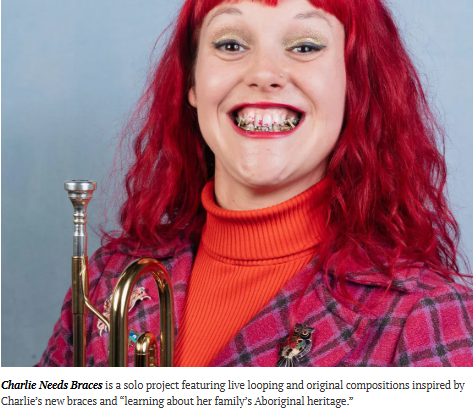
In recent years, Australia has witnessed an escalation in public claims to Aboriginal identity by individuals and groups lacking genealogical descent, community recognition, or cultural continuity. Among the most visible of these is Charlie Needs Braces, a musical project fronted by Melbourne-based performer Charlie Woods.

Through public statements, interviews, performances, and the 2024 documentary NYAA WA, Woods has asserted Aboriginal identity via alleged descent from the historical Carigal/Garigal leader Bungaree and his wife Matora, purporting to represent the “GuriNgai” people of Northern Sydney and the Central Coast. These claims are demonstrably false. Drawing upon a vast corpus of genealogical, historical, linguistic, anthropological, and community-sourced evidence, this report demonstrates conclusively that Charlie Needs Braces is not Aboriginal and cannot be said to represent any Aboriginal nation, language group, or family.

The identity claim rests on a discredited fabrication developed by the non-Aboriginal “GuriNgai” network, a settler cult operating across environmental, arts, and heritage sectors in New South Wales since the early 2000s (Cooke, 2025a; Wafer & Lissarrague, 2010). Charlie Woods’ public persona aligns with a broader pattern of settler simulation, affective mimicry, and race-shifting now recognised in national and international scholarship as Indigenous identity fraud (Andersen, 2019; Sturm, 2011). The false representation of Indigeneity by Charlie Woods is not confined to passive misapprehension; it is an active and monetised performance.
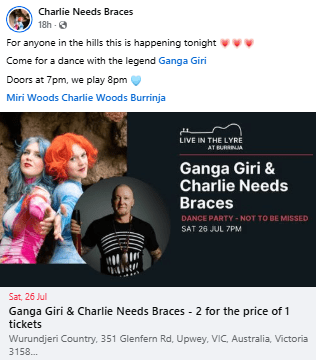
The project has received extensive institutional amplification through festival programs, grant funding, ABC and triple j media coverage, and digital music platforms including Bandcamp, Spotify, Apple Music, and YouTube. Each channel has promoted a settler-authored narrative of environmental guardianship, cultural authority, and ancestral belonging, despite clear and consistent opposition from recognised Aboriginal organisations and Elders, including those of the Marramarra Carigal family descended from Bungaree and Matora (Guringai.org, 2025a; Bungaree.org, 2024; Kwok, 2015).

This report critically interrogates the foundations, performance, and consequences of Charlie Woods’ fraudulent Aboriginal identity claim. It begins with a genealogical review and a deconstruction of the invented “Guringai” label, tracing its roots to colonial taxonomy and its exploitation by the GuriNgai group.
It then analyses the cultic, conspiratorial, and aesthetic dynamics of the NYAA WA project and associated social media content. Finally, it evaluates the institutional, legal, and ethical ramifications of cultural identity fraud in this case, and presents recommendations for reform, restitution, and the restoration of truth. Identity fraud of this nature has resulted in the misdirection of resources, the displacement of legitimate Aboriginal voices, the distortion of public record, and the retraumatisation of communities who continue to maintain cultural responsibilities to Country and kin. By documenting these harms and naming their source, this report seeks to uphold the principles of truth-telling and self-determination in Aboriginal cultural governance.

Methodology and Scope
This report applies a multidisciplinary and evidence-based approach to examine the Indigenous identity claims made by Charlie Needs Braces, with a particular focus on the genealogical, cultural, and institutional validity of these claims. The analysis synthesises forensic genealogy, historical linguistics, settler-colonial critique, cultic studies, and Indigenous governance frameworks, supported by extensive publicly available documentation. Key sources include guringai.org, bungaree.org, peer-reviewed academic texts, institutional records, social media analyses, and cultural impact statements.

2.1 Genealogical Forensics and the Tripartite Test
At the core of this investigation is the tripartite legal definition of Aboriginality in Australia, which requires that a person (1) is of Aboriginal descent, (2) identifies as Aboriginal, and (3) is recognised by a relevant Aboriginal community (Gardiner-Garden, 2003). While self-identification is one element of the test, it cannot stand alone. Genealogical documentation and community endorsement are essential. These are absent in the case of Charlie Woods.

The genealogical analysis relies on the forensic findings of Dr Natalie Kwok (2015), who investigated the claims of descent from Bungaree via a supposed daughter named “Sophy.” Kwok’s report, cited in both Guringai.org and Bungaree.org, finds no genealogical connection between Charlie Woods and the known descendants of Bungaree and Matora, nor any corroborating birth, baptismal, or census records supporting the claim (Guringai.org, 2025a; Bungaree.org, 2024). The “Sophy” narrative is identified as a post hoc fabrication used by members of the GuriNgai group to retroactively construct Aboriginal descent (Cooke, 2025b).

2.2 Content and Platform Analysis
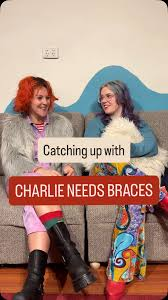
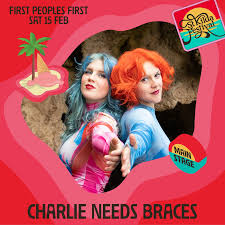
A wide-ranging review was conducted of public content produced or endorsed by Charlie Needs Braces, including media interviews, performance descriptions, artist bios, social media posts, and promotional material. This material spans over fifty sources, including the group’s official website, Bandcamp and YouTube channels, and appearances at events such as the Woodford Folk Festival, Rockhampton River Festival, and the Melbourne Documentary Film Festival. These platforms are used to perform faux-Aboriginality through environmental messaging, pseudo-spiritual references, and land-based aesthetics despite the lack of genealogical or community recognition (Charlieneedsbraces.com; YouTube, 2024; MDFF, 2025).

Special attention is paid to NYAA WA (2024), a short film and musical project that positions Woods as a cultural authority and spiritual custodian. The film, funded and platformed under the pretext of Aboriginal representation, is examined through the lens of ritualised settler simulation and cultural mimicry, building upon the framework developed by Cooke (2025c) and Tuck and Yang (2012).
2.3 Integration of Forensic Reports and Institutional Correspondence
The report integrates findings from institutional correspondence, including the 2020 joint letter from several Aboriginal Land Councils to the NSW Premier (Premier NSW Final Draft MLALC Letter, 2020), which categorically denies the legitimacy of Guringai/GuriNgai identity claims in Northern Sydney and the Central Coast. Further documentation includes the Aboriginal Heritage Office (AHO) Report (2015), the NPWS signage removal decision (2021), and multiple publications from Bungaree.org and Guringai.org demonstrating the fabricated nature of “GuriNgai” and associated identities (AHO, 2015; NPWS, 2021; Guringai.org, 2025a). Additionally, the analysis draws from cultic studies and psychological frameworks to examine how belief perseverance, identity narcissism, and digital echo chambers sustain fraudulent claims, even in the face of overwhelming contradictory evidence (Lalich & Tobias, 2006; Harrelson, 2021; Cooke, 2025c).

2.4 Scope and Limitations
This report focuses on the substantiated elements of Woods’ public identity claims, their genealogical basis, institutional legitimisation, and cultural harms. It assesses Woods not as a private citizen, but as a public figure making cultural and institutional claims to Aboriginality, often in high-profile contexts. The report makes no moral judgment on spiritual beliefs or artistic expression per se; its concern lies in the public misrepresentation of Aboriginal Culture and identity, its institutional consequences, and its harms to legitimate Aboriginal communities. The analysis proceeds from the position that truth-telling, genealogical accountability, and Aboriginal governance are non-negotiable standards for cultural authority and representation.

Genealogical Assessment of Charlie Woods and the Bungaree Descent Claim
This section provides a forensic genealogical assessment of Charlie Woods, the frontwoman of Charlie Needs Braces, with particular scrutiny of her claim to be descended from the Aboriginal leader Bungaree and his wife, Matora. This purported ancestry has been cited in public interviews, performances, and the 2024 film NYAA WA, in which Woods positions herself as a GuriNgai woman with ancestral obligations to Country (Guringai.org, 2025a). The genealogical evidence, however, decisively refutes this claim.

3.1 The Myth of “Sophy” and the Bungaree Lineage
Charlie Woods’ narrative of Aboriginal descent rests on a now widely discredited claim: that Bungaree and Matora had a daughter named “Sophy” from whom Woods is allegedly descended (Guringai.org, 2024). This “Sophy” narrative was first introduced publicly in the 2010s and has no basis in historical, archival, or genealogical records. In contrast, the known children of Bungaree are well documented in colonial sources and missionary records, and none are named Sophy.
More significantly, no descendant line connects Sophy or any other Aboriginal person to the Woods family (Kwok, 2015). The claim to Bungaree descent appears to be a retrofitted narrative manufactured to gain cultural legitimacy, with “Sophy” functioning as a placeholder for a missing genealogical link. This is a classic hallmark of settler simulation, where untraceable or ambiguous figures are inserted into family trees to construct artificial continuity with prominent Aboriginal ancestors (Cooke, 2025b).

3.2 Dr Natalie Kwok’s Genealogical Report (2015)
The most definitive assessment of this ancestry claim is contained in the 2015 genealogical report by Dr Natalie Kwok, commissioned to investigate the Bungaree descent claims by members of the GuriNgai group, including the Woods family. Kwok’s report concludes: “The claim to descent from Bungaree is without genealogical basis and is contradicted by all available documentary evidence. The ‘Sophy’ narrative is genealogically implausible and historically unsupported” (Kwok, 2015, as cited in Guringai.org, 2024b). The report draws on parish records, civil birth and death registrations, electoral rolls, and census data spanning the mid-19th to 21st centuries. It found that the Woods family descends from Anglo-Celtic settler stock with no documentation of Aboriginal ancestry or association with Aboriginal communities.

3.3 Absence of Community Recognition
Even if genealogical ambiguity were present, claims to Aboriginal identity must be substantiated by community recognition (Gardiner-Garden, 2003). No recognised Aboriginal community organisation in Northern Sydney, the Central Coast, or New South Wales at large has ever formally recognised Charlie Woods as a member, custodian, or descendant of Bungaree. To the contrary, multiple community bodies have publicly disavowed the GuriNgai identity narrative and those associated with it, including Woods.

A joint statement from the Metropolitan Local Aboriginal Land Council and other LALCs (2020) declared unequivocally: “We do not recognise those persons… claiming to be the ‘Awabakal and Guringai People’ as being of Aboriginal descent; nor are they active members of our Aboriginal communities in the Sydney/Newcastle Region” (Premier NSW Final Draft MLALC Letter, 2020, p. 2). Additionally, Bungaree.org, the cultural and genealogical platform established by Marramarra Carigal family, Bungaree and Matora’s legitimate descendants, has published multiple victim impact statements objecting to the co-option of their lineage by unconnected individuals (Bungaree.org, 2024).

3.4 Forensic Comparison: The Carigal vs. the Woods Line
A comparison between the verified Carigal lineage and the Woods family history reveals no point of overlap. Bungaree’s descendants, including Sarah Biddy Lewis and her descendants, are traceable through birth certificates, baptismal records, land occupation files, and oral histories (Bungaree.org, 2024). The Carigal line remains active today through the Marramarra Carigal community. In contrast, the Woods family lineage documented through electoral and civil records shows no Aboriginal identification until the late 2010s, coinciding with the period in which the GuriNgai simulation gained cultural and institutional momentum. Charlie Woods’ own artistic biography prior to this period made no mention of Aboriginal identity.

3.5 Strategic Motivations and Race-Shifting Patterns
Charlie Woods’ claim to Aboriginal identity fits a broader phenomenon identified in the scholarly literature as race-shifting or “pretendianism”, the strategic assumption of Indigenous identity for cultural capital, institutional access, or spiritual legitimacy (Andersen, 2019; Sturm, 2011).
These patterns often emerge without verifiable descent or community approval and rely on vague family lore, spiritual dreams, or oral myths disconnected from genealogical evidence. The identity performance by Woods and her collaborators cannot be interpreted as a sincere error of ancestry. It is a deliberate and strategic identity assumption, maintained despite a well-documented public record of opposition and refutation.

The GuriNgai Simulation and Its Fabricated Foundations
Charlie Woods’ claims to Aboriginal identity are inseparable from the broader settler performance known as the GuriNgai simulation, a network of individuals, organisations, and cultural campaigns that has operated across Northern Sydney and the Central Coast of New South Wales since the early 2000s. This identity network is premised on the appropriation of the colonial-era term “Guringai” and the strategic construction of a pseudo-tribal narrative that lacks any basis in linguistics, genealogy, or community continuity. Woods’ invocation of the “GuriNgai” identity aligns her with this fabrication and amplifies its harm through artistic and institutional platforms.
4.1 The Invented Ethnonym: From Gringai to GuriNgai
The term “Guringai” was not a self-ascribed name used by any Aboriginal community of the Sydney Basin. Rather, it was a colonial invention, first advanced by John Fraser in 1892, who collapsed multiple distinct language groups under a single imagined tribe stretching from Port Jackson to the Macleay River (Fraser, 1892). This misclassification was adopted by Arthur Capell and later reinforced in local signage, museums, and school curricula, despite never being supported by Aboriginal oral history or contemporary linguistic research. The foundational work of Wafer and Lissarrague (2010), The Kuringgai Puzzle, established beyond doubt that “GuriNgai” was an artificial linguistic construct with no traditional legitimacy.

Their analysis demonstrated that the name originated in colonial phonetic mishearings of the Gringai (now Guringay) people, whose Country lies north of the Hunter River, far outside the claimed GuriNgai region (Wafer & Lissarrague, 2010; Lissarrague & Syron, 2024). The paper Guringaygupa djuyal, barray (Lissarrague & Syron, 2024) further distinguishes the authentic Guringay language from the misappropriated GuriNgai narrative applied to the Sydney coast.

4.2 The Institutionalisation of Fraud
Despite overwhelming linguistic and genealogical refutation, the “GuriNgai” identity was embedded into local policy, heritage interpretation, and environmental activism through a process of institutional laundering. Non-Aboriginal individuals, including Neil Evers, Amanda Jane Reynolds, Tracey Howie, and others, adopted the GuriNgai name to assert cultural authority across a range of domains: Welcome to Country performances, tourism, cultural heritage assessments, and educational initiatives (Integrated Report on Aboriginal Identity Fraud, 2024).
These claims were then given the appearance of legitimisation through uncritical partnerships with local councils (e.g. Hornsby, Central Coast, Northern Beaches), heritage authorities, and cultural festivals, many of which failed to implement verification protocols or consult recognised Aboriginal Communities, organisations, or actual legislated authorities (Hornsby Shire Council Report, 2025; Cooke, 2025a).
The Guringai Tribal Link Aboriginal Corporation (GTLAC), a central actor in the simulation, routinely offered cultural services while failing to demonstrate either genealogical evidence or community recognition. The 2020 joint letter from multiple Aboriginal Land Councils, including the Metropolitan LALC and Darkinjung LALC, made the situation explicit: “We do not recognise those persons… claiming to be the ‘Awabakal and Guringai People’… any claim that Guringai or Awabakal people are from the Northern Sydney or Central Coast areas is false and should be rejected” (Premier NSW Final Draft MLALC Letter, 2020, p. 2).

4.3 Cultic Dynamics and Settler Conspirituality
By the 2010s, the GuriNgai simulation had evolved beyond bureaucratic misidentification into a form of settler cultism. Members of the group began hosting pseudo-ceremonial events, eco-spiritual workshops, and simulated men’s business rituals that bore no resemblance to authentic Aboriginal practice. Jake Cassar, a prominent environmentalist affiliated with the GuriNgai network, merged survivalist ideology, conspiratorial belief, and Aboriginal simulation into public ceremonies and spiritual performances (Guringai.org, 2025d). This mode of operation draws from New Age spirituality, ecological mysticism, and identity narcissism to construct a performative ‘Aboriginality’.
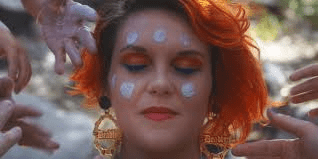
It strategically mimics Indigenous protocols while rejecting their genealogical foundations and governance frameworks. These cultic features include hierarchical control, charismatic leadership, ritual appropriation, and the use of social media to curate a spiritualised digital identity (Lalich & Tobias, 2006; Harrelson, 2021). Charlie Woods’ performance in NYAA WA, and the broader public identity of Charlie Needs Braces, is directly tied to this cultic dynamic. Her musical persona, imagery, and promotional material all evoke themes of land, animal kinship, and ancestral knowledge, despite lacking any cultural authorisation or kinship recognition (Guringai.org, 2025b). Her alignment with the GuriNgai simulation is not incidental; it is central to her public narrative and artistic legitimacy.
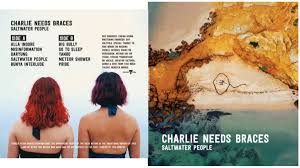
4.4 Settler Mimicry and Strategic Identity Fraud
The GuriNgai simulation exemplifies what scholars of Indigenous identity fraud call settler mimicry: a process by which non-Indigenous individuals simulate Aboriginality through affect, performance, and symbolic possession (Moreton-Robinson, 2015; Tuck & Yang, 2012). This mimicry is not a benign misapprehension; it is a deliberate act of cultural fraud aimed at accessing social, political, and economic capital reserved for Indigenous peoples. The persistent use of the GuriNgai identity in public domains, despite decades of corrective evidence from Aboriginal organisations, linguists, and genealogists, makes clear that this is not a case of mistaken belief.

As outlined in The Implausibility of Mistaken Identity in the GuriNgai Simulation (2025), there is no plausible way for central members of the GuriNgai network, including Woods, to remain unaware of the extensive evidence refuting their claims (Guringai.org, 2025c). Rather, the performance of Aboriginal identity by Charlie Woods functions as part of a wider pattern of cultural expropriation, epistemic domination, and symbolic recolonisation of Aboriginal land and narrative space. It perpetuates harm to legitimate Aboriginal communities while diverting resources and cultural attention to false authorities.

NYAA WA and the Aestheticisation of Cultic Identity Performance
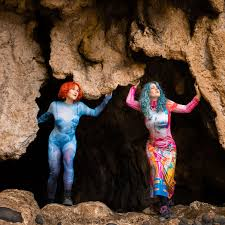
The 2024 short film and music project NYAA WA is the central artistic vehicle through which Charlie Woods publicly performs her fabricated Aboriginal identity. Styled as an intergenerational narrative of Aboriginal womanhood, land connection, and cultural memory, the film deploys affective aesthetics, ambient imagery, and a heavily curated soundtrack to simulate Indigenous experience. However, as this section demonstrates, NYAA WA is not a representation of Aboriginal culture, it is a theatrical artefact of cultic settler mimicry. It aestheticises and monetises cultural fraud under the guise of Aboriginal storytelling.

5.1 The Premise of NYAA WA: Manufactured Lineage and Emotional Authority
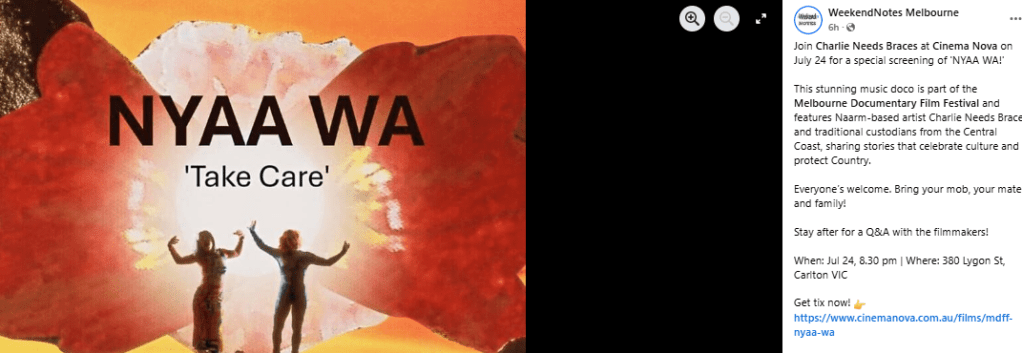
Marketed as a tribute to “mob” and ancestral connection, NYAA WA claims to tell the story of Charlie Woods’ matrilineal line, invoking a fictitious continuity between Woods, the Guringai people, and the historical figures of Bungaree and Matora. The title itself, stylised as a spiritual affirmation, reinforces the illusion of authenticity by invoking a sacred-sounding lexicon without linguistic grounding in any verified Aboriginal language (Guringai.org, 2025a). In interviews and promotional materials, Woods claims that “a lot of the music is derived from my mob” and that the project is about “healing Country through music” (Beat Magazine, 2024; MDFF, 2025). However, forensic analysis of the film’s content, promotional language, and soundtrack confirms that these claims are performative projections. There is no evidence that Woods belongs to a recognised Aboriginal mob, let alone one with a continuous lineage from Bungaree or the Central Coast. The claim to cultural authority in NYAA WA is not supported by any LALC, community organisation, or recognised Aboriginal governance body. On the contrary, multiple Aboriginal Elders and researchers, including Elizabeth McEntyre and Robert Syron, have publicly condemned the project as an act of cultural misrepresentation and identity fraud (Guringai.org, 2025b).
5.2 Ritual Aesthetics, Emotional Performance, and Settler Spiritual Projection
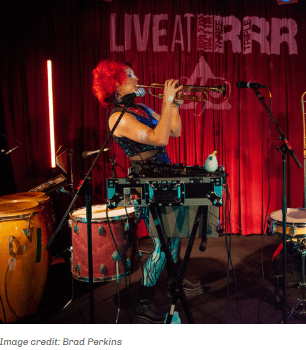
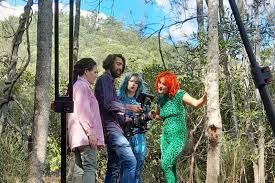
Visually and sonically, NYAA WA blends psychedelic imagery, looper-based trumpet lines, and environmental soundscapes with staged “cultural” performances walks on Country, river reflections, animal cutaways, and voiceovers about inherited strength.

These cinematic tropes draw from settler environmentalist aesthetics and New Age spiritual traditions rather than Aboriginal ceremonial practice. This performative strategy reflects what Cooke (2025b) identifies as the “aestheticisation of sovereignty”, where settler artists simulate cultural knowledge through affective mood, emotional appeal, and ecological styling without governance, kinship, or accountability. In the case of NYAA WA, Woods appropriates the lexicon and visual palette of Aboriginal cultural work while fundamentally lacking the protocols, permissions, or responsibilities that give such work legitimacy. The film, far from being an authentic cultural artefact, operates as a spiritual spectacle: a curated ritual designed to elicit settler empathy, institutional support, and arts recognition. It fits within the broader paradigm of settler conspirituality described in recent analyses of the GuriNgai simulation (Guringai.org, 2025c; Cooke, 2025a).
5.3 Performance, Funding, and Institutional Endorsement
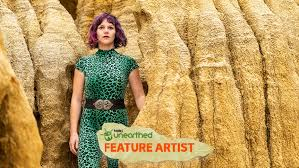
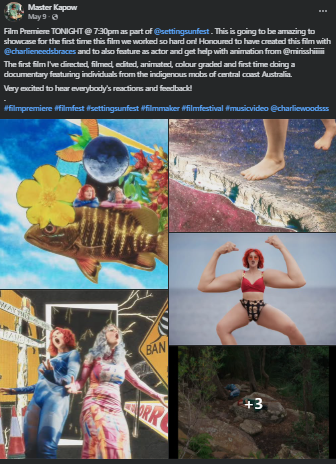
NYAA WA was produced and promoted with the backing of several arts and film bodies, including festival slots at the Melbourne Documentary Film Festival (MDFF, 2025), promotion via feminist and music platforms (Feminista Vinyl, Triple J Unearthed, Women in Pop), and reviews across mainstream and social media. Promotional materials were streamed on YouTube, featured on Spotify and Apple Music, and actively promoted via the band’s Instagram and Facebook platforms, where claims of GuriNgai identity were repeated uncritically (Instagram, 2025; YouTube, 2024). These endorsements occurred despite longstanding public evidence disproving the identity claims on which the film and artist’s public persona are based. The Aboriginal Heritage Office Report (2015), the Kwok Genealogy Report (2015), and repeated public statements from recognised Aboriginal communities had already disavowed the Guringai and Bungaree descent narratives advanced by Woods (AHO, 2015; Kwok, 2015; GuriNgai.org, 2023; Bungaree.org, 2024).
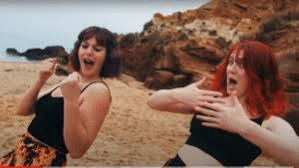
5.4 The Film as a Ritual Artefact of Cultic Identity Fraud
NYAA WA is best understood not as a documentary or art film, but as a ritual artefact of cultic identity fraud. It functions as a public declaration of self-anointed Aboriginality, reinforced by cinematic mood and spiritual framing, but unsupported by kinship, community, or evidence. It draws heavily on the aesthetic norms of environmentalism, spiritual feminism, and Indigenous solidarity movements, without being grounded in any Aboriginal cultural jurisdiction.
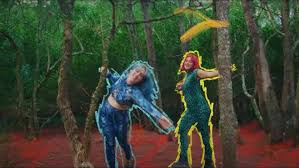
This type of artefact has precedent in global Indigenous identity fraud. Comparable cases include pretendian performances in North America, where non-Indigenous artists claim ancestry and produce art as a medium of self-Indigenisation (Teillet Report, 2021; Harrelson, 2021). What distinguishes NYAA WA is its ritualised integration into the GuriNgai cultic simulation, a simulation built not only on false genealogy, but on collective settler belief, institutional complicity, and emotional manipulation.
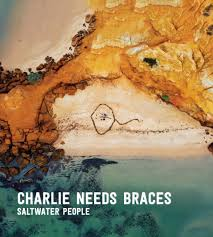
The film is therefore not merely misleading, it is spiritually exploitative. It invokes Aboriginal ancestors, speaks on behalf of Country, and gestures toward ceremonial knowledge while being authored by individuals who have been categorically rejected by the very communities they claim to represent.
Digital Platforms and Settler Self-Promotion
The public identity of Charlie Needs Braces is not constructed through cultural lineage, community recognition, or Aboriginal governance. It is constructed online, through an orchestrated and highly curated digital presence that performs Aboriginality through aesthetics, branding, and symbolic language. This section examines how Charlie Woods, through the Charlie Needs Braces brand, uses digital platforms to amplify and monetise fraudulent identity claims, actively resisting correction from Aboriginal communities while cultivating an echo chamber of settler validation.

6.1 Platform Strategy: Simulating Aboriginality in the Attention Economy
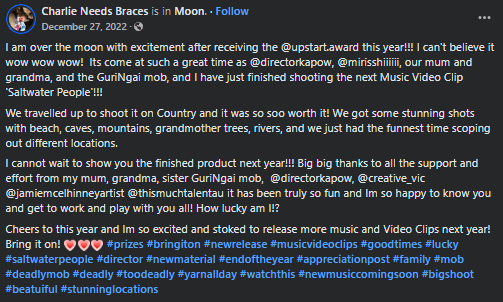
The brand’s digital footprint spans Bandcamp, Instagram, Facebook, YouTube, Apple Music, SoundCloud, Linktree, and event aggregators like Moshtix, Sofar Sounds, and Woodfordia. Across these platforms, Woods consistently asserts an ‘Aboriginal identity’ by invoking language such as “my mob,” “traditional custodianship,” “protecting Country,” and “GuriNgai Nation.” These claims are made without reference to genealogical descent, community membership, or any actual Aboriginal community recognition (Instagram, 2025; Linktree, 2025; Bandcamp, 2024). The aesthetic signature of Charlie Needs Braces combines lo-fi indie visuals with Indigenous-adjacent symbolism: dot-pattern motifs, ochre colour palettes, bushland backdrops, and environmental language associated with Aboriginal ecological stewardship. These cues function as what Moreton-Robinson (2015) terms “white possessive logics,” wherein the settler subject projects a claim of care or belonging onto Country as a substitute for cultural legitimacy. Such claims are consistently accepted by platform algorithms, media outlets, and funding bodies, which often fail to require formal verification of Aboriginality. The result is a feedback loop in which Woods’ fabricated identity is algorithmically affirmed, aesthetically rewarded, and institutionally normalised.

6.2 Hashtag Echo Chambers and Algorithmic Insulation
Woods and her team use hashtags such as #Guringai, #AlwaysWasAlwaysWillBe, #BlakArt, #ProtectCountry, and #SaltwaterPeople to embed themselves within Indigenous digital discourse. These hashtags are not just promotional tools; they are legitimacy signals, designed to position Woods within the visual, political, and emotional terrain of Aboriginality. However, this strategy also creates algorithmic insulation. By framing her content in explicitly pro-Indigenous terms, Woods deflects critique by signalling solidarity.
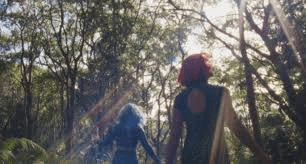
Aboriginal voices who challenge her claims are often blocked, deleted, or ignored in comment sections, while settler followers and festival promoters respond with praise and affirmation (Guringai.org, 2025a). This curatorial control allows Woods to maintain a spiritualised persona while excluding accountability and dissent. As outlined in The Implausibility of Mistaken Identity in the GuriNgai Simulation (2025), this digital insulation reinforces belief perseverance among followers, many of whom have no access to or awareness of the genealogical and community-based standards for Aboriginality (Guringai.org, 2025c). The effect is epistemic: the performance of authenticity becomes more visible than truth.
6.3 Institutional Collaborations and Cultural Capital Accumulation
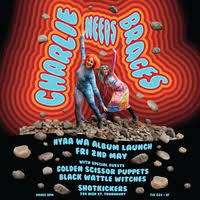
Woods’ digital persona has enabled her to partner with a wide array of institutions that rely on visible Indigenous representation to meet diversity benchmarks, including ABC triple j Unearthed, the Melbourne Documentary Film Festival, Forté Magazine, and the Australian Independent Record Labels Association. These platforms have uncritically accepted Woods’ claims to Aboriginal identity, often publishing biographical material written or authorised by her directly (AIR, 2025; Beat Magazine, 2024; MDFF, 2025). This institutional complicity functions as a form of cultural laundering: the transformation of fraudulent identity claims into accepted truths through repetition, visibility, and platforming. As described in the Integrated Report on Aboriginal Identity Fraud (2024), such laundering embeds false claimants within public memory and policy processes, effectively displacing legitimate Aboriginal voices. Woods’ presence at festivals such as Woodford Folk Festival, Rockhampton River Festival, Castlemaine Fringe, and Wominjeka further entrenches her performance of Aboriginality in the public imagination, while drawing funding, bookings, and media attention that would otherwise support authentic Aboriginal artists and community members (Woodfordia.org, 2025; Castlemaine Fringe, 2025).

6.4 The Ethical Crisis of Digital Identity Fraud
The digital identity of Charlie Needs Braces is not simply inaccurate; it is an ethical and cultural transgression. It harnesses the symbolic power of Aboriginality without the relational accountability that underpins genuine Aboriginal cultural expression. This violation is compounded by the platform architecture of digital media, which rewards aesthetic signalling and emotional resonance over community verification. Unlike Aboriginal artists, who must navigate internal accountability mechanisms and collective responsibilities, Woods operates with total autonomy. Her self-declared Aboriginality is neither confirmed nor contested by any governance structure internal to the platforms she uses. In this context, digital Indigeneity becomes a brand, a story, a mood; stripped of its genealogical, historical, and political foundations. This is what Cooke (2025b) terms “identity theatre”: a curated performance of sovereignty that conceals the absence of descent, kinship, and Country. It replaces truth-telling with storytelling, and replaces cultural governance with emotional branding.

Institutional Complicity and Cultural Laundering
The fabrication and performance of Aboriginal identity by Charlie Needs Braces would not have been as prolonged as it was without the structural failures and active complicity of institutions across the cultural, media, arts, educational, and governmental sectors. This section analyses how institutions have enabled, legitimised, and amplified fraudulent claims to Aboriginal identity by Charlie Woods and the wider GuriNgai network. It also explores how this complicity has contributed to a broader system of cultural laundering: the transformation of falsehood into perceived truth through uncritical repetition and public endorsement.
7.1 The Failure of Identity Verification Protocols
Despite the availability of clear, accessible, and community-supported evidence refuting the GuriNgai narrative and Woods’ individual claims, institutions have repeatedly failed to apply identity verification standards. Universities, music festivals, grant bodies, and local councils have engaged Woods and her collaborators as Aboriginal speakers, performers, and cultural authorities without requiring documentation of descent or recognition from an Aboriginal community (Guringai.org, 2025a; Bungaree.org, 2024). This failure constitutes a breach of both legal and ethical obligations. The tripartite test of Aboriginality (descent, self-identification, and community recognition), is widely accepted in both law and policy (Gardiner-Garden, 2003). Yet in Woods’ case, institutions have relied solely on self-identification. This has enabled a situation in which performance is mistaken for truth, and fraud is mistaken for culture. The 2020 joint letter from multiple Aboriginal Land Councils to the NSW Premier made the institutional position clear: the GuriNgai identity has no legitimacy and should not be used to justify cultural authority, land claims, or representational roles (Premier NSW Final Draft MLALC Letter, 2020). Institutions that ignore such warnings engage in epistemic violence and contribute to the ongoing dispossession of legitimate Aboriginal families.

7.2 MDFF and the Platforming of Identity Fraud
One of the most illustrative examples of institutional complicity is the Melbourne Documentary Film Festival’s (MDFF) selection and promotion of NYAA WA. The festival accepted the film despite its creators’ widely known association with the non-Aboriginal GuriNgai group. The festival initially withdrew the film but later considered reversing its decision, citing lobbying from Senator Lidia Thorpe – lobbying that Senator Thorpe’s Office denies took place (Guringai.org, 2025d). This reflects a broader institutional tendency to avoid conflict with performative indigeneity, particularly when presented by individuals who are media-savvy, emotionally appealing, and aligned with seemingly progressive aesthetics (Cooke, 2025b).

7.3 Arts Organisations and Media Outlets
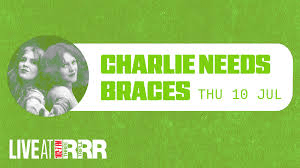
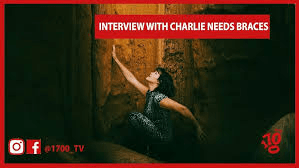
Numerous arts and music organisations have played a role in laundering Woods’ identity narrative. These include but are not limited to triple j Unearthed, ABC Rage, PBS FM, RTR FM, Castlemaine Fringe Festival, Bigsound, and Air.org.au. These platforms have published artist biographies, broadcast songs, and produced interviews that uncritically repeat Woods’ claims to Aboriginal identity and her alleged Guringai heritage (Beat Magazine, 2024; ABC, 2024; AIR, 2025). Such institutional amplification does not occur in a vacuum. It depends on a system of editorial negligence, aesthetic fetishism, and bureaucratic convenience.

Woods’ story fits the template many media organisations seek: an Indigenous woman reclaiming voice, healing Country, and leading a cultural revival. The contradiction between this narrative and the genealogical record is rarely investigated. Instead, identity is inferred through the lens of performance, tone, and thematic alignment with dominant multicultural and environmental narratives. This process is what Cooke (2025b) and Moreton-Robinson (2015) describe as “epistemic laundering”: a form of institutional mimicry in which simulated Aboriginality is repeatedly platformed until it becomes discursively indistinguishable from legitimate cultural authority. Once embedded in media archives, arts databases, and festival line-ups, these claims are difficult to reverse—even after exposure.

7.4 Councils, Land Managers, and Public Consultation Failures
Local councils and land management agencies have also played a key role in giving false legitimisation to GuriNgai claims. Hornsby Shire Council, Central Coast Council, and Northern Beaches Council have all at various points included GuriNgai claimants in advisory groups, signage, land management plans, and public consultations (Hornsby Shire Report, 2025; Cooke, 2025a). In many cases, these endorsements were made against the objections of local Aboriginal communities, LALCs, and cultural knowledge holders. The NSW National Parks and Wildlife Service (NPWS), in contrast, removed Guringai/GuriNgai from signage in 2021 after receiving forensic evidence of identity fraud, demonstrating that correction is possible when institutions act in good faith and consult with Aboriginal communities (Guringai.org, 2024a). The NPWS response stands as an exception in a broader landscape of institutional inertia and complicity. The continued engagement of councils and government agencies with Woods and the broader GuriNgai network, despite public exposure of the fraud, constitutes a dereliction of duty. These institutions have not only ignored warnings but have provided public resources, legitimacy, and cultural platforming to individuals engaged in settler simulation.

7.5 The Consequences of Complicity: Cultural and Structural Harm
Institutional complicity in identity fraud is not a neutral failure. It inflicts direct and measurable harm on Aboriginal communities. It displaces legitimate representatives from governance structures, misdirects funding and attention, undermines genealogical truth, and contributes to a broader cultural atmosphere in which Aboriginal identity is treated as performative, optional, and unanchored from kinship or Country.

The platforming of Charlie Needs Braces as an Aboriginal act erases genuine Aboriginal people, community and culture, including but not limited to actual documented Aboriginal descendants of Bungaree and Matora. It reduces our lived history and inherited responsibilities to the backdrop for a settler’s artistic brand. It also tells other fraudulent claimants that they will not be held accountable, and that false Aboriginalality, when aestheticised and emotionalised, can bypass scrutiny.

Harm to the Broader Aboriginal Communities
The assertion of a fabricated Aboriginal identity by Charlie Needs Braces, and its amplification through digital and institutional channels, has had direct, cumulative, and structural consequences for the Aboriginal community and Aboriginal families connected to Northern Sydney, the Central Coast, and the legacy of Bungaree and Matora. This section outlines the types of harm produced, cultural, epistemic, representational, economic, psychological, and intergenerational, and situates them within the broader dynamics of Indigenous identity fraud in Australia.

8.1 Cultural Displacement and Simulated Sovereignty
Charlie Woods’ appropriation of the Guringa/GuriNgaii name, combined with her claimed descent from Bungaree & Matora and public alignment with the so-called GuriNgai group, represents a direct attack on the culture and sovereignty of the actual descendants of Bungaree and Matora (Guringai.org, 2025a; Bungaree.org, 2024). These false claims overwrite real cultural memory with settler mythology, presenting an alternative, fabricated lineage as the legitimate custodian story of the region. This form of cultural displacement, undermines the authority of community-sanctioned knowledge holders and reorients public recognition toward fraudulent figures. It damages cultural continuity by replacing genuine transmission of knowledge with performative storytelling and aesthetic mimicry.
The appropriation of Bungaree’s name is particularly egregious. Bungaree is a foundational figure in the history of Aboriginal-settler relations, and his legacy is held in trust by his descendants. To invoke his name without descent, consent, or recognition constitutes a profound violation of cultural law and kin-based governance (Kwok, 2015; Guringai.org, 2025d).
8.2 Psychological and Community Harm
For the Aboriginal community, the public celebration of Charlie Needs Braces has been experienced not as inclusion but as erasure. Members of the community have described feelings of betrayal, grief, and dispossession as they witness their history distorted and commodified by a non-Aboriginal performer (Bungaree.org, 2024; Cooke, 2025b). Repeated attempts to speak out have been met with dismissal, hostility, or strategic silence from festival organisers, media platforms, and institutions that continue to elevate Woods. This psychological harm is compounded by the dynamics of gaslighting and deflection that accompany settler fraud. As explored in The Implausibility of Mistaken Identity in the GuriNgai Simulation (2025), many fraudulent claimants rely on strategic ambiguity and spiritualised language to avoid accountability, framing critique as “division” or “lateral violence.” In doing so, they deflect responsibility and shift the emotional burden onto Aboriginal communities who are forced to prove their own truth while simultaneously disproving another’s fiction.

8.3 Economic Disadvantage and Opportunity Loss
Every opportunity given to Charlie Needs Braces on the basis of a fabricated Aboriginal identity constitutes an opportunity denied to an actual Aboriginal person. From festival bookings and music grants to press coverage, cultural consultation roles, and film festival programming, Woods has received financial and reputational benefits under false pretences (Beat Magazine, 2024; MDFF, 2025). These benefits are extracted not just from institutions, but from the public trust and cultural capital owed to Aboriginal people.
This dynamic is not hypothetical. It reflects a zero-sum reality in which funding for Aboriginal arts, representation quotas, cultural positions, and performance slots are finite. The platforming of Woods actively displaces artists from Aboriginal communities with legitimate cultural authority and lived connection to Country. As outlined in How Indigenous Identity Fraud Undermines Policy, Sovereignty, and the National Agreement on Closing the Gap (2024), such appropriation also distorts the metrics of Aboriginal participation in the creative economy, making it appear as though Indigenous voices are being supported while, in reality, settler simulation occupies the stage (Guringai.org, 2025f).
8.4 Impact on Data Sovereignty and Identity Governance
Fraudulent identity claims such as those made by Woods also contribute to broader epistemological harms. They distort demographic data, misinform public policy, and undermine efforts to establish and protect genealogically grounded definitions of Aboriginality. As the Integrated Report on Aboriginal Identity Fraud (2024) makes clear, unverified claims dilute the effectiveness of Closing the Gap initiatives and corrode Indigenous data sovereignty frameworks (Cooke, 2024). The presence of fraudulent actors in Aboriginal statistics, grant databases, and cultural rosters creates what the Statistical Sabotage report (2025) calls “identity inflation”: the artificial expansion of Indigenous identity categories through self-identification unmoored from descent or community (Biddle & Markham, 2018). This has measurable consequences for funding allocation, health policy, education planning, and reconciliation efforts. Woods’ continued presence in publicly available artist databases, educational curricula, and arts funding programs contributes to this distortion, helping to embed her performance of Aboriginality within institutional memory and data repositories.

8.5 Intergenerational Consequences and the Normalisation of Fraud
Perhaps the most dangerous consequence of institutional failure in this case is the message it sends to future generations: that Aboriginal identity is aesthetic, that performance can substitute for descent, and that cultural authority can be assumed without governance. Woods’ example creates a precedent in which settler Australians are encouraged to spiritualise, simulate, and selectively identify as Indigenous without genealogical grounding or community connection. This sets a dangerous standard for both cultural engagement and anti-racism efforts. It teaches non-Aboriginal people that claiming to be Aboriginal is a matter of belief or story, not history or kinship. It also signals to Aboriginal people that their identity, authority, and history can be stolen, re-authored, and sold. Such normalisation does not occur in a vacuum. It is enabled by media platforms, artistic institutions, councils, and audiences who fail to scrutinise identity claims, and who value emotional resonance over cultural legitimacy. The result is a form of structural racism masquerading as inclusion: the replacement of Aboriginal people by non-Aboriginal claimants who are more palatable to settler expectations.

Conclusion
The case of Charlie Needs Braces and its entanglement with the fraudulent GuriNgai narrative presents a sobering lesson in the failures of identity governance, cultural accountability, and institutional responsibility in contemporary Australia. Through a detailed forensic investigation of genealogical records, institutional endorsements, artistic content, and public discourse, this report has demonstrated that Charlie Woods is not Aboriginal, has no verifiable descent from Bungaree or Matora, and is not representative of any recognised Aboriginal community on the Central Coast, in Northern Sydney, or anywhere else in Australia. The evidence is clear: Woods’ claimed identity is a recent construct, emerging within the last five years, built upon a discredited lineage narrative and promoted in close alignment with the non-Aboriginal GuriNgai group. Her artistic output is embedded in settler mimicry and spiritualised simulation rather than in intergenerational cultural knowledge or sanctioned community authority. The public reception of her work, including the promotion of NYAA WA as an Aboriginal film, reflects a wider system of aesthetic validation that rewards emotional appeal and environmental themes while ignoring the tripartite test of Aboriginality: descent, self-identification, and community recognition. The consequences of this fraud are not merely symbolic. They include the erasure of the Aboriginal People, culture and community, the distortion of data used in Closing the Gap initiatives, the economic displacement of Aboriginal artists, and the psychological burden placed on communities forced to defend their histories against settler revisionism. Woods’ visibility as a performer claiming Aboriginal identity under false pretences sends a dangerous signal that cultural identity can be performed, purchased, and platformed without consequence. Institutions, including film festivals, broadcasters, educational bodies, and government agencies, have played a central role in enabling this identity fraud. Their failure to verify claims, consult community, or correct public misinformation constitutes complicity in a process of cultural laundering. This complicity undermines reconciliation, corrodes Indigenous governance, and disrespects the sovereignty of Aboriginal peoples. The truth must now be unequivocally stated: Charlie Needs Braces is not Aboriginal, is not connected to Bungaree, Matora, or the Guringai, and cannot speak for or represent any Aboriginal Nation. The cultural, legal, genealogical, and ethical weight of evidence refutes her claims entirely. This report calls on institutions, funding bodies, and the public to withdraw recognition, rescind awards or programs grounded in identity fraud, and commit to truth-telling through genuine consultation with Aboriginal communities.
Glossary of Key Terms
Aboriginality (Tripartite Test): A legal and policy framework requiring that a person must (1) be of Aboriginal descent, (2) self-identify as Aboriginal, and (3) be recognised by the Aboriginal community to which they claim to belong.
Cultural Laundering: The institutional process by which a fabricated or fraudulent cultural identity is normalised through repetition and endorsement, leading to public legitimacy despite lack of evidence.
Epistemic Violence: The erasure, distortion, or marginalisation of knowledge systems—particularly Indigenous ways of knowing—through settler frameworks and institutional complicity.
GuriNgai: A non-Aboriginal group in Northern Sydney and the Central Coast that has appropriated the discredited term “Guringai” and fabricated genealogical narratives to claim Aboriginal identity and cultural authority.
Marramarra Carigal: The Aboriginal community that holds legitimate genealogical descent from Bungaree and Matora.
Simulated Sovereignty: The act of claiming custodianship, cultural authority, or Aboriginal identity without descent or community recognition, often via performance, aesthetics, or settler belief systems.
Spiritualised Identity Claims: Assertions of Aboriginality based not on descent or community connection but on personal feelings, dreams, visions, or beliefs, often used to bypass verification.
Statistical Sabotage: The distortion of Aboriginal demographic and policy data through the inclusion of unverified claimants, impacting the effectiveness of programs like Closing the Gap.
 Bungaree.org
Leave a comment