This article critically evaluates the genealogical and historical claims made by Tracey Howie and her family, particularly regarding their asserted descent from the renowned Aboriginal leaders Bungaree and Matora of Broken Bay. Drawing on genealogical records, expert anthropological opinion, DNA testing, native title documentation, and archival material, the analysis demonstrates that the descent claim is unsupported by verifiable evidence. The piece further contextualises the implications of identity construction within broader frameworks of Indigenous identity fraud, settler colonial mimicry, and the institutional harms caused by cultural misrepresentation.
The proliferation of false claims to Aboriginal identity in Australia has created profound legal, cultural, and social consequences for Indigenous peoples, particularly in areas where cultural authority and territorial rights are under constant contestation. In recent decades, a phenomenon of ‘self-Indigenisation’ has emerged, where non-Aboriginal individuals assert unverified Aboriginal ancestry to access resources, assert cultural influence, or acquire political leverage (Leroux, 2019; Carlson, 2016). This paper investigates the case of Tracey Howie, founder of the Guringai Tribal Link Aboriginal Corporation, who claims descent from Bungaree and Matora through a largely undocumented line involving a woman named ‘Sophy.’
The analysis draws on multiple sources: anthropological reports, native title tribunal decisions, genealogical records, oral history interviews, and formal statements from Aboriginal Land Councils. It examines how narrative, affective language, and spiritual rhetoric are used to construct an Indigenous identity without verifiable genealogical or communal backing. This case is emblematic of the broader challenges faced by Aboriginal communities in resisting the erasure and replacement of legitimate cultural authority.
Tracey Howie’s claimed descent from Bungaree and Matora hinges on a proposed matrilineal link through Charlotte Ashby, whom she identifies as a daughter or descendant of Bungaree. However, archival research, including the work of historian Keith Vincent Smith (2011), confirms that Bungaree had a daughter named Biddy (also known as Sarah Wallace, Sarah Lewis, and Biddy Salamander), but no known children named or linked to Charlotte Ashby. The National Native Title Tribunal found no credible evidence supporting the claimants’ connection to land, leading to the withdrawal of the Awabakal and Guringai claim in 2017 (National Native Title Tribunal [NNTT], 2020).
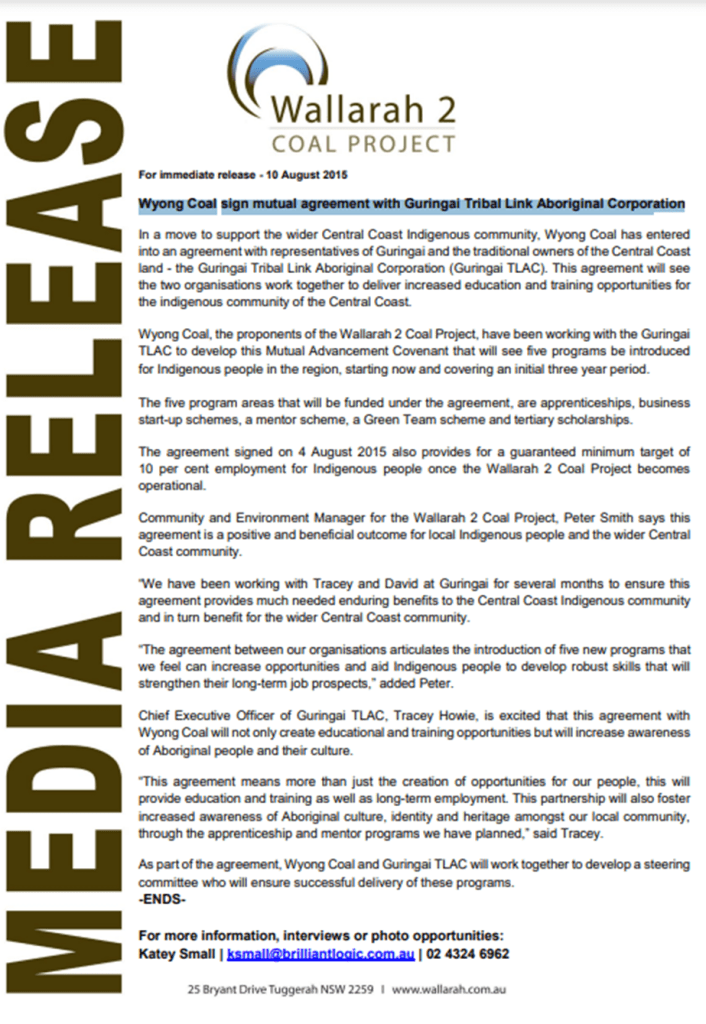
A 2015 anthropological report prepared by Nicole Kwok further concluded that Howie’s claimed lineage through ‘Sophy’ was genealogically incoherent. The report noted that ‘Sophy’ appeared as a name in the family’s oral traditions but had no clear documentary existence or known kinship placement that could establish a continuous connection to the Broken Bay area. DNA testing conducted in subsequent years failed to show any Aboriginal ancestry for key members of the Howie-Whitfield family (Kwok, 2015).
This lack of genealogical continuity has been further confirmed by Guringay cultural authorities in the ‘Guringaygupa Djuyal Barray’ report (Syron & Lissarrague, 2024), which clarified that the Guringay people are located in the Dungog, Gloucester, and upper Hunter River regions—not on the Northern Beaches or Central Coast. The conflation of Guringay with ‘Guringai’—a 20th-century colonial linguistic invention—has been comprehensively debunked (Aboriginal Heritage Office, 2015).
A deeper discourse analysis of Howie’s and Whitfield’s interviews reveals recurring linguistic strategies designed to assert cultural legitimacy while circumventing traditional mechanisms of community accountability. Their language relies heavily on affective authenticity, a term used to describe the invocation of personal emotion and spiritual revelation as a substitute for verifiable cultural belonging (Vannini & Williams, 2009).
In Howie’s narrative, the use of passive voice and metaphor reflects a discursive shift away from historical evidence toward experiential assertion. Phrases such as “I walk in both worlds” or “the ancestors tell me I belong” invoke metaphysical certainty that resists interrogation. This style constructs a sacred epistemology that places personal intuition above the collective authority of Aboriginal community governance. Such discourse mirrors settler-colonial forms of new-age Indigeneity, where Aboriginality is presented as a spiritual archetype rather than a social, political, and genealogical identity (Leroux, 2019).
Howie’s language is similarly constructed around mythopoetic frames. Her invocation of dreams, ancestral visitations, and emotional kinship to place avoids the standard evidentiary frameworks expected in Aboriginal community validation. She leverages spatial familiarity—“being on the land”—as a stand-in for belonging, echoing a logic that conflates occupation with ownership. By positioning settler presence as sufficient for Indigeneity, Whitfield participates in what Moreton-Robinson (2015) terms the white possessive logic: a settler structure of feeling that transforms access to Country into claims of rightful ownership.
Both Howie, Whitfield, and their GuriNgai followers demonstrate a pattern of shifting discourse from communal belonging to individual feeling. They substitute collective continuity with personal revelation, and kinship accountability with emotional certainty. Their language privileges introspective authority over external verification—an approach which, while rhetorically compelling to some audiences, fundamentally bypasses Aboriginal law, kinship obligations, and communal recognition.
These discursive manoeuvres are not benign. They enable the performance of Indigeneity in contexts where the material and cultural authority of real Aboriginal peoples is being actively contested—such as in land development disputes, council heritage listings, and educational settings. The rhetorical elevation of personal truth over communal history allows these actors to narratively dispossess legitimate Aboriginal communities, even as they claim to speak on their behalf.
Their coordinated claims are reinforced through shared media appearances, letters to council, and joint involvement in cultural events. In this context, the oral histories they offer—though archived by major institutions—must be read critically, as artefacts of appropriation rather than genuine testimonies of cultural continuity. The performance of Aboriginal identity by these non-Indigenous actors contributes to the structural displacement of legitimate Aboriginal voices, particularly in matters of land use, cultural heritage, and political representation.
The claim by Tracey Howie to be descended from Bungaree and Matora is demonstrably false. The genealogical record provides no evidence of descent from Sophy, who is herself a conflated and likely fictional figure. DNA evidence confirms no Aboriginal ancestry, and no recognised Aboriginal community acknowledges Howie as kin. This fraudulent narrative has enabled the formation of the GuriNgai movement, a coordinated and well-resourced campaign that has appropriated Aboriginal cultural authority and undermined legitimate self-determination. The public record—including formal letters from Aboriginal Land Councils, anthropological analysis, and native title decisions—demands that institutions cease recognising or endorsing Guringai as a valid identifier for Country in Northern Sydney or the Central Coast. Future policy must be guided by Aboriginal-led frameworks of community recognition, verifiable descent, and cultural integrity.
JD Cooke
References
Aboriginal Cultural Authority on the Central Coast. (2021). Discussion paper on cultural authority and Aboriginal identity fraud in the Central Coast region. Darkinjung LALC.
Aboriginal Heritage Office. (2015). Filling a void: A review of the historical context for the use of the word ‘Guringai’. https://www.aboriginalheritage.org
Carlson, B. (2016). The politics of identity: Who counts as Aboriginal today? Aboriginal Studies Press.
Cooke, J. D. (2025). Tracey Howie and family: False claims to Bungaree ancestry. https://guringai.org/2025/01/07/tracey-howie-and-family/
DLALC. (2022). Submission to Central Coast Council: First Nations Accord process, May 2022. Darkinjung Local Aboriginal Land Council.
Fraser, J. (1892). An Australian language as spoken by the Awabakal. Government Printer.
Kwok, N. (2015). Anthropological Connection Report Part 2: Family history and contemporary connection evidence: Awabakal and Guringai People NC2013/002. Guringai Tribal Link Aboriginal Corporation. https://guringai.org/2023/09/06/tracey-howie-and-family-guringai-tribal-link-aboriginal-corporation/
Leroux, D. (2019). Distorted descent: White claims to Indigenous identity. University of Manitoba Press.
Metropolitan Local Aboriginal Land Council (MLALC). (2020). Letter to NSW Premier re: false Guringai claims to Northern Sydney and Central Coast. https://guringai.org/2023/07/07/chapter-4-2009-2012/
Moreton-Robinson, A. (2015). The white possessive: Property, power, and Indigenous sovereignty. University of Minnesota Press.
National Library of Australia. (2009). Interview with Tracey-Lee Howie by Rob Willis [Audio recording]. Rob and Olya Willis Folklore Collection. https://catalogue.nla.gov.au/Record/4735539
National Native Title Tribunal. (2020). NC2013/002 Awabakal and Guringai People application—withdrawn determination.
State Library of New South Wales. (2001). Interview with Warren Whitfield by Rosemary Block, 7 September 2001 [Transcript]. Mitchell Library, Oral History Collection.
Syron, R., & Lissarrague, A. (2024). Guringaygupa djuyal barray: The true story of Guringay country, language, and identity.
Vannini, P., & Williams, J. P. (2009). Authenticity in culture, self, and society. In P. Vannini & J. P. Williams (Eds.), Authenticity in culture, self, and society (pp. 1–20). Ashgate.
 Bungaree.org
Leave a comment