Jake Cassar, the founder of Coast Environmental Alliance (CEA) and the public face of Jake Cassar Bushcraft, has cultivated a charismatic persona that aligns closely with the model of ‘entrepreneurial spiritual leadership’ described by Angela Coco (2023), in which individual authority is derived from perceived access to spiritual truths rather than institutional recognition.
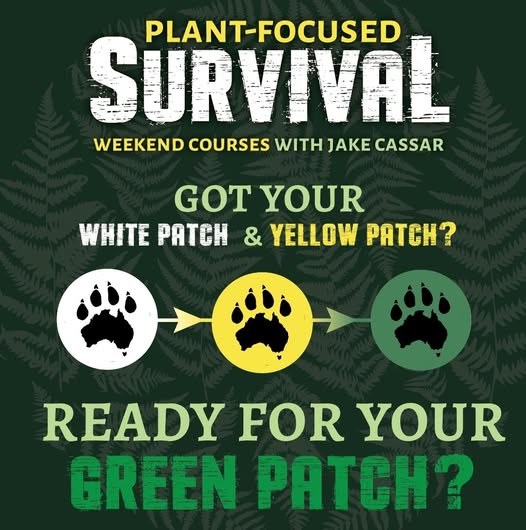
His carefully crafted identity combines bush survivalism, apocalyptic prophecy, and spiritualised faux-environmentalism, reflecting what scholars such as Ferretti (2023) and Crockford (2021) have characterised as the fusion of esoteric ecology and conspiratorial counter-modernity.
Through this convergence of doomsday prepping culture and settler-conspiritualist ideology, Cassar has successfully embedded himself within communities of environmental concern, using fear-based narratives and mythic constructions of land and destiny to build a loyal follower base while simultaneously undermining Aboriginal land rights and governance.

Cassar’s strategy centres on the circulation of apocalyptic themes: the impending collapse of society, ecological disaster, government tyranny, and spiritual warfare.
These narratives resonate with the wider prepper movement, which has gained momentum in Australia during times of crisis such as the COVID-19 pandemic. Cassar has featured prominently in survivalist media, where he emphasises his ability to “survive indefinitely in the bush” and trains followers in urban and wilderness survival, harvesting bush food, making shelters, and defending against an unstable future (ABC, 2016; SBS, 2023).
These teachings, while marketed as practical and empowering, function ideologically to reinforce mistrust of governmental and scientific institutions, thereby fostering a climate of conspiracy receptivity and anti-social pluralism (Crockford, 2021; Fetterman et al., 2019; Jarzabkowski, Unger, & Meissner, 2023).
Unlike mainstream environmental education, which emphasises empirical knowledge, collective stewardship, and structured collaboration with Indigenous communities (Kaslon, 2019; Lyons et al., 2022), Cassar’s pedagogy is individualistic, alarmist, and couched in a hypermasculine ethos of self-reliance and territorial defence.
Furthermore, in contrast to Indigenous land-based pedagogies that centre reciprocity, relationality, and cultural continuity (Aikenhead & Michell, 2011; Yunkaporta, 2020), Cassar’s teachings instrumentalise Country as a survival resource, thereby transforming sacred land into a theatre of settler endurance and mythic struggle.

Cassar’s use of survivalist narratives cannot be disentangled from his political messaging. Through CEA, he promotes campaigns such as “Save Kariong Sacred Lands” and “Save Kincumber Wetlands,” often in partnership with the non-Aboriginal GuriNgai group.
These campaigns invoke Aboriginal spirituality and custodianship but are grounded in false identity claims and settler fantasy (Cooke, 2025a; guringai.org, 2025). Cassar himself is not Aboriginal but positions himself as an eco-spiritual leader aligned with so-called Traditional Custodians who lack genealogical legitimacy.

His campaigns frequently invoke debunked pseudoarchaeological sites, a tactic that serves settler colonial aims by fabricating sacred geographies disconnected from actual Aboriginal knowledge systems, thereby legitimising non-Indigenous claims to cultural authority and belonging.
As observed by scholars of pseudoarchaeology and settler colonialism, such appropriations often function to displace Indigenous narratives and embed settler identities within a spiritualised but ahistorical framework of land attachment (Weiser, 1974; Metraux, 1953; Watego, 2021).

This model closely mirrors what Angela Coco (2023) describes as charismatic spiritual leadership within New Age cults: the blending of mystical language, social alienation, and utopian longing into a performative narrative of transformation and insider access to truth.

Cassar’s followers are encouraged to see themselves as spiritual warriors, enacting a performative identity that offers emotional gratification through perceived moral clarity, collective belonging, and spiritual mission.
Drawing on affective attachments common to high-control groups and conspiritualist movements (Ferretti, 2023; Rondini, 2019), this framing mobilises fear, hope, and transcendence as psychological mechanisms of devotion and behavioural compliance.
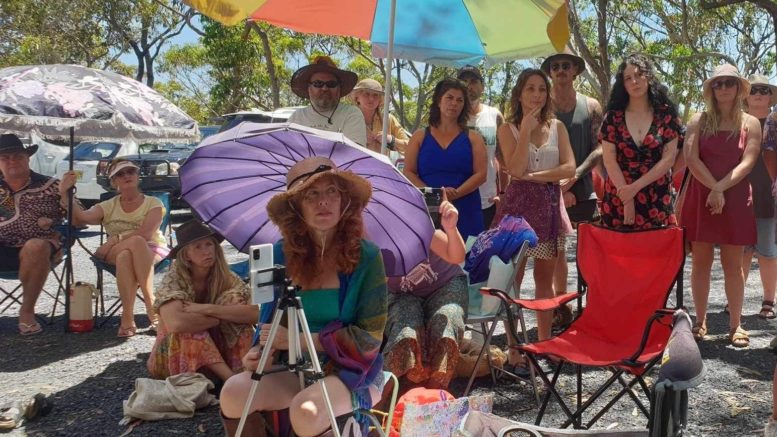
In this context, Cassar’s doomsday prepping functions as a recruitment and control mechanism. Followers are drawn into a worldview in which he becomes both prophet and protector, offering knowledge of how to survive the end-times while positioning his political campaigns as spiritually ordained resistance.
Through bushcraft trainings, online posts, and CEA rallies, Cassar instils an ethic of radical self-reliance combined with distrust of institutions, which further entrenches dependence on his leadership. These are classic features of high-control groups, as described in Singer (2003), Zablocki (2001), and Anthony and Robbins (2004), including staged public performances where Cassar directs group survival activities, narrates apocalyptic scenarios, and positions his own interpretation of current events as spiritually significant and uniquely authoritative.
At his training sessions, for instance, followers report being instructed to rehearse defensive bush tactics against hypothetical government intrusions, reinforcing the us-versus-them worldview typical of cultic environments (Rondini, 2019; Coco, 2023).

What makes Cassar’s approach particularly harmful is its fusion of settler myth-making with environmental populism and anti-Aboriginal activism. As noted in Moreton-Robinson’s (2015) theory of white possessiveness, campaigns that appear to defend the land often do so through a framework of white entitlement and Indigenous displacement.
Cassar’s opposition to the DLALC’s development projects frames legitimate Aboriginal land governance as a corporate threat to the environment, while erasing the very Aboriginal voices who hold cultural and legal authority (Guringai.org, 2025; Bungaree.org, 2025).
Furthermore, by embedding himself in spiritual conspiracist networks such as My Place and amplifying tropes common to QAnon and New World Order conspiracies—as analysed by Berghel (2022), Cassar creates ideological overlaps between ecological doomsday prepping and far-right anti-government sentiment (Gillespie, 2025; Cohen, 2025; Berghel, 2022).

These networks reject pluralistic governance and Indigenous sovereignty, favouring instead a return to imagined pre-modern community forms steeped in nationalism and spiritual purity. In doing so, Cassar weaponises ecological concern to serve settler interests, a phenomenon akin to what Cochrane, Gillespie, and Ross (2024) describe as the masculinist bushcraft turn in far-right settler identity formation.
In conclusion, Jake Cassar’s use of apocalyptic narratives and doomsday prepping is not a benign expression of environmental concern or personal resilience. It is a coercive ideological strategy that entwines charismatic authority, cultic dynamics, pseudo-Indigenous claims, and ecological anxiety to build a cult movement.
This movement erodes trust in public institutions, undermines Aboriginal sovereignty, and necessitates urgent Aboriginal-led counter-strategies grounded in cultural resurgence, truth-telling, and institutional accountability. These may include public education campaigns that centre Indigenous authority, critical literacy initiatives that expose pseudo-Indigenous claims and conspiracy ideologies, and policy reforms that strengthen protections against cultural misrepresentation while supporting community resilience and ethical environmental stewardship.
References
ABC. (2016). Meet the survivalists preparing for the apocalypse. https://www.abc.net.au/triplej/programs/hack/meet-survivalists-massing-bee-pollen-preparing-for-apocalypse/7303642
Aikenhead, G. S., & Michell, H. (2011). Bridging cultures: Indigenous and scientific ways of knowing nature. Pearson Canada.
Anthony, D., & Robbins, T. (2004). Conversion and “brainwashing” in new religious movements. In L. L. Dawson (Ed.), Cultic milieus and spiritual communities (pp. 243–267). Elsevier.
Berghel, H. (2022). The unifying myth of the New World Order. Computer, 55(2), 98–102. https://doi.org/10.1109/MC.2022.3147233
Bungaree.org. (2025). Jake Cassar and the politics of settler conspirituality, ecofascism, identity fraud, and the war against Aboriginal land rights on the Central Coast. https://bungaree.org/2025/06/18/jake-cassar-and-the-politics-of-settler-conspirituality-ecofascism-identity-fraud-and-the-war-against-aboriginal-land-rights-on-the-central-coast
Cochrane, A., Gillespie, B., & Ross, K. (2024). Hegemonic masculinity and the far-right in Australia: Bushcraft, violence, and settler identity. Australian Journal of Political Science, 59(2), 201–220. https://doi.org/10.1080/10361146.2024.00000
Coco, A. (2023). Cultic cultures in Australia: Religious authority, control and resistance. Springer.
Cohen, M. (2025). Prefigurative neoliberalism and the global sovereign citizen movement. Routledge.
Cooke, J. (2025a). The false mirror: Settler environmentalism, identity fraud, and the undermining of Aboriginal sovereignty on the Central Coast. Guringai.org. https://guringai.org/2025/06/06/the-false-mirror-settler-environmentalism-identity-fraud-and-the-undermining-of-aboriginal-sovereignty-on-the-central-coast/
Crockford, S. (2021). Ripples of the universe: Spirituality in the age of science. University of Chicago Press.
Ferretti, S. (2023). Contemporary conspirituality: Gender, immortality, meme culture. Religion and Society, 14(1), 88–106.
Fetterman, A. K., Landau, M. J., & Cox, C. R. (2019). On post-apocalyptic and doomsday prepping beliefs: A new measure, its correlates, and the motivation (or lack thereof) to prepare. Personality and Individual Differences, 149, 250–258. https://doi.org/10.1016/j.paid.2019.05.055
Gillespie, B. (2025). Anti-government rage: Understanding, identifying and responding to the sovereign citizen movement in Australia. Australian Security Policy Centre.
Guringai.org. (2025). Jake Cassar and Coast Environmental Alliance (CEA). https://guringai.org/2025/06/17/jake-cassar-and-coast-environmental-alliance-cea/
Jarzabkowski, J., Unger, S., & Meissner, F. (2023). Extremist movements in Australia: A study of individual ideology. Australian National University Press.
Kaslon, A. J. (2019). Sustainability pedagogies in Australian schools: Measuring hope and resilience [Poster presentation]. Society for Personality and Social Psychology.
Lyons, K., Torres, C., & Della-Porta, A. (2022). Indigenous leadership in climate change and sustainability education. Journal of Environmental Education, 53(4), 238–256.
Metraux, D. A. (1953). The cultural function of pseudoarchaeology in the United States. Japanese Journal of Religious Studies, 24(1/2), 139–154.
Moreton-Robinson, A. (2015). The white possessive: Property, power, and Indigenous sovereignty. University of Minnesota Press.
Rondini, A. C. (2019). Post-truth epistemologies and the cultic self. Cultural Studies Review, 25(2), 54–74. https://doi.org/10.5130/csr.v25i2.6432
SBS. (2023). Meet the everyday Australians prepping for the end of the world. https://www.sbs.com.au/news/insight/article/meet-the-everyday-australians-prepping-for-the-end-of-the-world/p0gm0iz6j
Singer, M. T. (2003). Cults in our midst: The continuing fight against their hidden menace (Rev. ed.). Jossey-Bass.
Weiser, M. (1974). Effects of prophetic disconfirmation and dissonance reduction on conversion and proselytisation. Journal for the Scientific Study of Religion, 13(1), 67–75.
Watego, C. (2021). Another day in the colony. University of Queensland Press.
Yunkaporta, T. (2020). Sand talk: How Indigenous thinking can save the world. Text Publishing.
Zablocki, B. (2001). The blacklisting of a concept: The strange history of the brainwashing conjecture in the sociology of religion. Nova Religio, 1(2), 96–121.
 Bungaree.org
Leave a comment