Part 1: Introduction, Historical Context, and Early Chronology
The controversy surrounding the so-called “GuriNgai” identity represents one of the most extensive and consequential cases of Indigenous identity fraud in contemporary Australia. It exemplifies how colonial misclassifications, genealogical fabrications, and institutional failures can intersect to distort cultural truth and undermine the sovereignty of legitimate Aboriginal communities.
What began as a local issue in Northern Sydney and the Central Coast but has since grown into a national example of how epistemic insecurity within institutions enables cultural appropriation, policy capture, and settler simulation. The fabricated identity of the “GuriNgai mob” and its offshoot organisations has been widely exposed through genealogical, linguistic, and legal research. Yet, despite clear evidence from Aboriginal Land Councils, anthropological reports, and government correspondence, various councils and cultural institutions continue to reference “GuriNgai Country,” perpetuating a colonial fiction that displaces legitimate Aboriginal custodians.
The origins of this distortion can be traced to a nineteenth-century academic error that metastasised into a twenty-first-century movement of settler mimicry. The ethnonym “Kuringgai,” later rendered “Guringai” and later “GuriNgai,” was coined by missionary John Fraser in 1892, who incorrectly extended the name of the Gringai people north of the Hunter River to invent a vast “Kuring-gai tribe” stretching from the Macleay River to south of Sydney. This speculative classification conflated multiple distinct cultural groups and languages, effectively erasing regional diversity in favour of an imagined pan-tribal entity. Fraser’s construction was subsequently dismissed by later linguists, including Wafer and Lissarrague (2010), who demonstrated that no primary linguistic data supported his claims and that the term “Kuringgai” did not appear in any verified early colonial records. Nevertheless, Fraser’s fiction persisted, entering maps, museums, and eventually council acknowledgements, providing the scaffolding for future identity fraud.
Linguistic evidence confirms that the genuine Guringai/Guringay, sometimes rendered as Gringai or Guringgay, are an Aboriginal group whose traditional Country lies north of the Hunter River, in the Barrington, Dungog, Paterson, Allyn, and Williams River region of New South Wales. The modern spelling Guringai/Guringay reflects a linguistically corrected version of the original Gringai, derived from comparative analysis with the Gathang dialect continuum, which includes Birrbay (Biripi) and Warrimay (Worimi). Lissarrague and Syron (2024) demonstrate that the Guringai/Guringay language is a dialect of Gathang, showing distinct grammatical structures and vocabulary that separate it from the Hunter River and Lake Macquarie (HRLM) language documented by Threlkeld and Biraban. Maps in Howitt’s ethnographic archives clearly place the Gringai between the Paterson, Allyn, and Williams Rivers, extending toward the Barrington Tops, leaving no linguistic or geographical justification for applying the term south of the Hunter.
The Aboriginal Heritage Office (AHO) substantiated these findings in Filling a Void: A Review of the Historical Context for the Use of the Word “Guringai” (2015), confirming that there is “no record of the word ‘Kuringgai’ in the early colonial accounts” and that Fraser’s classification was “anachronistic and without ethnographic justification.” The AHO report traces the word’s modern use to its adoption by local councils and educational institutions seeking a regional Indigenous identifier, noting that its popularity arose precisely because of the absence of consultation with genuine Traditional Custodians. In this way, “Guringai” functioned as a symbolic placeholder; an easy solution to institutional discomfort with the complexity of Aboriginal diversity. This historical vulnerability became a fertile environment for contemporary bad actors to exploit, creating the conditions for what has since become known as the “GuriNgai Fraud, the Gurigai Hoax, and the GuriNgai Cult.
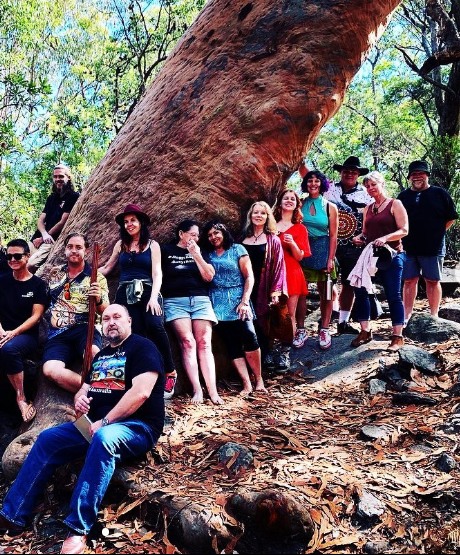
The earliest phase of the recent ongoing fraud (2001–2008) unfolded through the creation of the Guringai Tribal Link Aboriginal Corporation (GTLAC), an entity registered by Warren Whitfield in 2003. Whitfield, a non-Aboriginal man, drew on fragments of the outdated “Kuringgai” myth to invent a new “tribal” identity centred on Northern Sydney and the Central Coast. As documented in the Guringai.org timeline (Chapter 1, 2001–2023), Whitfield’s project gained initial traction through uncritical partnerships with non-Aboriginal individuals and groups eager to meet legislative requirements for Aboriginal consultation. The creation of GTLAC allowed non-Indigenous individuals to present themselves as “custodians,” gaining access to cultural grants, land negotiations, and policy influence despite lacking genealogical or community validation.
This phase also coincided with the emergence of a genealogical fiction linking the group to Bungaree and Matora, the well-documented Aboriginal leaders from the Sydney–Broken Bay region. The fraudulent genealogy claimed that Bungaree and Matora had a fictional daughter named Sophy, whose supposed descendants included Charlotte Ashby and her children. However Cultural knowledge, oral history, the historical record, and the archival and anthropological research by Dr Natalie Kwok conclusively refuted this lineage, demonstrating that no record exists of a “Sophy” or “Charlotte” connected to Bungaree’s verified family. Ashby’s death certificate lists her mother as “Sophia, surname unknown,” and the 1831 Blanket Returns contain no evidence linking Bungaree’s known family to the Brisbane Water district. The continued promotion of this fiction constitutes what the AHO characterises as “pseudohistory,” a distortion of the historical record designed to legitimise modern political or cultural claims.
The period between 2007 and 2008 marks the consolidation of the GuriNgai identity as a public narrative. During these years, self-proclaimed representatives such as Tracey Howie, Laurie Bimson, and Neil Evers began publicly performing “Welcome to Country” ceremonies in Northern Sydney and the Central Coast, asserting custodianship on behalf of the fictional “Guringai Nation.” Howie, who would later become CEO of GTLAC, described herself as an Aboriginal Elder and law-woman from the “Wannangine” and “Walkaloa” clans, identities with no documented historical basis. Evers, likewise, acknowledged in interviews that he was unaware of any Aboriginal ancestry until a cousin “found all of our family’s history,” a statement indicative of the recent and unverified nature of these claims. The ability of such figures to gain institutional legitimacy underscores the systemic problem of verification in heritage governance, where local councils often equate self-identification with authenticity, fearing that refusal could be construed as discriminatory.
This was also the era in which the GuriNgai narrative began to enter the cultural mainstream. Local councils such as Ku-ring-gai and Northern Beaches adopted “Guringai” in their Acknowledgements of Country, while schools and heritage consultants followed suit. Public signage, interpretive materials, and cultural programming began to feature the term, giving a veneer of legitimacy to an identity that had never existed in the historical or linguistic record. The emergence of online content further amplified the myth, with GTLAC and affiliated individuals producing websites and promotional materials that claimed continuity with pre-invasion ancestors. These digital spaces, as Guringai.org documents, became critical tools of epistemic laundering: the process by which fabricated or unreliable information gains perceived legitimacy through repetition and institutional endorsement.
By 2008, the “GuriNgai” identity had become entrenched in local government and heritage discourse, setting the stage for the next decade of expansion and institutional entanglement. The same epistemic vulnerability that allowed Fraser’s error to persist for a century was now being exploited to reconstruct identity within the frameworks of reconciliation and multicultural inclusion. The transition from linguistic error to identity fraud reveals the persistence of settler colonial logics: systems that erase Indigenous authority by replacing it with simulations of authenticity.
The linguistic and genealogical evidence now provides an unequivocal foundation for rejecting these claims. The genuine Guringai/Guringay people, whose Country lies north of the Hunter River, are linguistically, culturally, and genealogically distinct from the peoples of Northern Sydney and the Central Coast. Historical records, including those of Boydell, Mathews, and Howitt, confirm that the Gringai occupied the Dungog and Gloucester districts and spoke a dialect of Gathang, not the HRLM language. The use of the term “Guringai” south of the Hunter River is therefore not only inaccurate but constitutes cultural misappropriation.
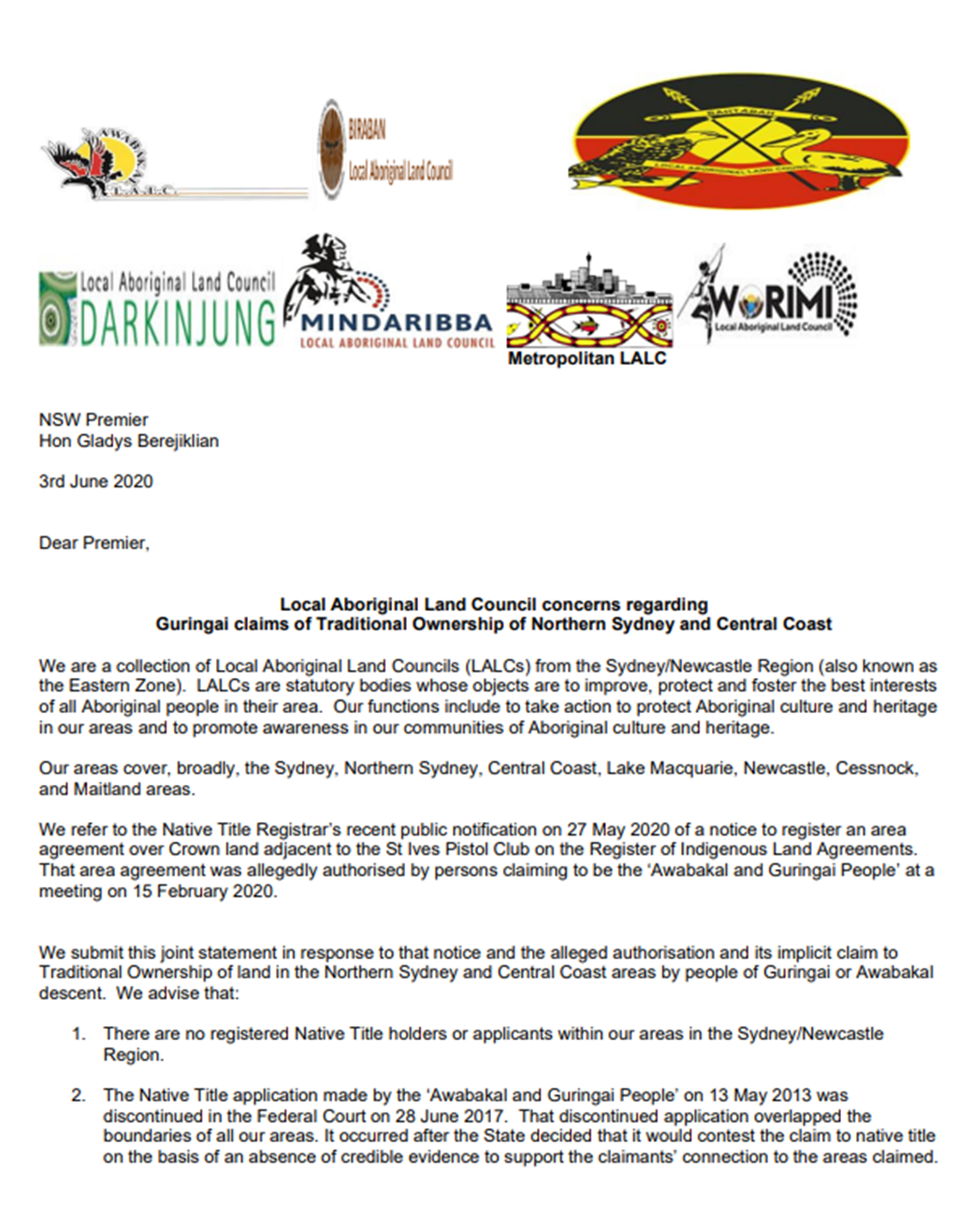
The legal framework reinforces this conclusion. There is no recognised Aboriginal group in the Northern Beaches, Hornsby Council, or Central Coast regions known as “Guringai” or “GuriNgai” under the Aboriginal Land Rights Act 1983 (NSW) or the Native Title Act 1993 (Cth). The Registrar of the Aboriginal Land Rights Act confirmed in correspondence to the National Native Title Tribunal (21 August 2020) that the so-called “Awabakal and Guringai People” Indigenous Land Use Agreement (ILUA) was not authorised by any registered Aboriginal owners and that the claim group was not recognised under NSW law. Similarly, a joint letter from seven Local Aboriginal Land Councils (Metropolitan, Awabakal, Bahtabah, Biraban, Mindaribba, Worimi, and Darkinjung), dated 3 June 2020, affirmed that while the term “Guringay” refers to the historically recognised people of the Dungog–Barrington region, there is “no evidence that such a group ever occupied, spoke for, or held cultural authority in Northern Sydney or the Central Coast.”
By embedding false identity within heritage policy and educational programming, the “GuriNgai” project represents not simply a misreading of history but a deliberate act of epistemic colonisation. It replaces authentic genealogical and cultural evidence with simulacra; representations that imitate the form of Aboriginal identity while severing it from its relational, community-based foundations. The result is a landscape in which truth and fabrication coexist within public institutions, eroding trust and perpetuating colonial domination through the appropriation of Indigenous symbols.
Part 2: Consolidation, Institutional Entrenchment, and the Expansion of the Fraud (2009–2016)
By 2009, the GuriNgai construct had matured from an isolated fiction into an organised network with significant reach across local government, cultural programming, and environmental activism. This phase, documented in Guringai.org Chapters 4–6, saw the deliberate institutionalisation of false identity claims through partnerships, grant applications, and the increasing conflation of GuriNgai representatives with legitimate Aboriginal custodians. This process exemplified what social theorists term epistemic capture: the absorption of fabricated or distorted knowledge into systems of governance and policy where it begins to shape outcomes, displace truth, and manufacture authority.
The cultural landscape of the Central Coast and Northern Sydney during this period was marked by a rapid proliferation of false “heritage” narratives. The Guringai Tribal Link Aboriginal Corporation (GTLAC), operating under the leadership of Tracey Howie, began positioning itself as a representative Aboriginal organisation for the region, despite no recognition under the Aboriginal Land Rights Act 1983 (NSW). This positioning was aided by strategic alliances with environmental and heritage bodies seeking Aboriginal consultation partners for project approval processes under the National Parks and Wildlife Act 1974 (NSW). As Guringai.org’s investigative chronology illustrates, GTLAC members engaged with local councils, museums, and schools, offering “Welcome to Country” services and cultural training workshops, thereby generating both income and social legitimacy.
One of the most consequential partnerships of this period was the arrangement between GTLAC and Wyong Coal, formalised around 2010. The agreement provided GTLAC with employment and training benefits in exchange for the group’s endorsement of mining operations on the Central Coast. As later shown by the Darkinjung Local Aboriginal Land Council (DLALC) and NTSCORP (2020), these agreements constituted a form of policy capture, whereby an unverified organisation without genealogical legitimacy gained material and political advantage through its appropriation of Aboriginal identity. This exploitation of reconciliation frameworks, intended to empower Aboriginal participation, in fact displaced genuine Aboriginal voices.
The years 2013–2014 (Chapter 5 of Guringai.org) marked the beginning of intensified public critique. Aboriginal communities, researchers, and legitimate cultural authorities began to challenge the growing misuse of “Guringai” in Northern Sydney and the Central Coast. The Aboriginal Heritage Office’s Filling a Void report (2015) directly addressed the historical inaccuracy of the term, urging councils to cease its use and to consult recognised Aboriginal stakeholders. The report explicitly concluded that the “word ‘Guringai’ does not have a verified linguistic, cultural, or historical connection to the region south of the Hunter River.” Yet even after the release of this report, local governments and environmental organisations continued to adopt the GuriNgai narrative, reflecting what Lissarrague and Syron (2024) later describe as “the institutional inertia of colonial fiction.”
The 2015–2016 period revealed the deep entanglement between the GuriNgai identity network and settler environmentalist movements. Groups such as the Coast Environmental Alliance (CEA), led by Jake Cassar, began integrating GuriNgai representatives into campaigns opposing Aboriginal-led developments, including those managed by the Darkinjung LALC. Cassar and other CEA figures publicly identified as allies of “GuriNgai custodians,” constructing a powerful rhetorical image of white environmentalism framed as Indigenous guardianship. As Guringai.org documents in Chapter 6, this convergence of identity fraud and conspiritualist activism marked a new phase of settler simulation: the replacement of legitimate Aboriginal governance with its counterfeit in the form of a spiritually-inflected, settler-controlled “Indigenous” narrative.
These developments reflect the broader sociological mechanism described by Day and Carlson (2021) as settler self-Indigenisation; the process by which non-Indigenous individuals claim Aboriginal identity to resolve their own moral dissonance while preserving structural privilege. Within this framework, the GuriNgai identity functions as both personal absolution and political instrument, allowing settler participants to symbolically inhabit Indigeneity while continuing to benefit from the institutions of colonial power. This convergence of personal mythology and structural advantage lies at the core of the GuriNgai phenomenon: a fusion of invented genealogy, spiritual mimicry, and bureaucratic validation that transforms cultural theft into civic authority.
From a governance perspective, this phase underscores the weakness of inconsistent institutional verification mechanisms. Councils and agencies lacked the expertise and procedural frameworks to assess claims of Aboriginal descent, relying instead on trust, reputation, and performative sincerity. As a result, fraudulent actors were able to gain footholds in public decision-making processes, particularly within heritage assessments and cultural programming. The tendency to accept self-identification as evidence of authenticity stemmed in part from the legacy of multicultural policy, which prioritised inclusivity and goodwill over the complex realities of Aboriginal cultural law and kinship. Universities and local governments, fearful of accusations of racism, adopted policies that equated inclusion with uncritical acceptance, creating an epistemic environment where truth could be displaced by confidence.
The consolidation period also saw the rise of charismatic figures whose authority rested entirely on performative claims. Tracey Howie’s role as a self-described law-woman and Elder became institutionalised through her repeated involvement in heritage assessments and council consultations. Neil Evers, as a prominent spokesperson for GTLAC, was featured in media coverage as a cultural educator and advocate for reconciliation. The language used by these figures, emphasising “oneness,” “connection to Country,” and “healing”, mirrored that of authentic Aboriginal community leaders, yet lacked grounding in verifiable culture, kinship or community recognition. The sociologist Pierre Bourdieu’s concept of symbolic capital is directly applicable here: these individuals converted the appearance of Indigeneity into institutional and economic capital, leveraging cultural performance as a currency of legitimacy.
This period also marks the proliferation of epistemic laundering through digital means. The internet allowed the GuriNgai narrative to multiply across platforms, reinforcing falsehoods through repetition and algorithmic visibility. Council websites, school programs, and local media reproduced the fabricated identity as established fact. Guringai.org’s Chapter 7 traces how public exposure of this deception was met with defensiveness and moral posturing rather than corrective action, reflecting the moral economy of settler identity politics. The individuals and institutions complicit in the fraud were not necessarily driven by malice but by a desire to be seen as progressive, inclusive, and reconciliatory. This emotional economy of settler virtue made it difficult for genuine Aboriginal communities to challenge the deception without being accused of divisiveness or hostility.
By 2016, the structural embedding of the GuriNgai fraud had created a bifurcated reality: one in which the name appeared authoritative across public institutions, and another where Aboriginal communities and scholars were documenting its falsity in increasingly urgent terms. The Aboriginal Heritage Office, Darkinjung LALC, and Metropolitan LALC all reiterated that the genuine Guringay belong north of the Hunter River, while the Sydney–Hawkesbury–Broken Bay region is associated with other historically verified language groups. Despite these authoritative statements, the fabricated GuriNgai identity continued to expand through council recognition, environmental partnerships, and the arts sector.
This tension between truth and fabrication set the stage for the next era (2017–2023), when identity fraud and institutional complicity would converge fully in the Hornsby Shire Council context. As the digital archive Guringai.org records, this period not only witnessed the entrenchment of pseudohistory in policy and education but also the emergence of counter-movements dedicated to reclaiming genealogical truth and restoring cultural authority.
Part 3: Institutional Complicity, Hornsby Shire Council, and the Reassertion of Cultural Authority (2017–2023)
Between 2017 and 2023, the non-Aboriginal GuriNgai identity network reached its peak of institutional acceptance, despite the mounting weight of genealogical, linguistic, and legal evidence refuting its existence. As documented in Guringai.org Chapters 7 through 12, this period witnessed the consolidation of false authority through a combination of local government endorsement, environmental activism, and artistic representation, culminating in the Hornsby Shire Council controversy. This phase marks the point where epistemic distortion evolved into a structural problem of governance, transforming a genealogical fiction into a publicly recognised cultural identity through bureaucratic repetition and symbolic legitimacy.
The institutionalisation of the fraud was facilitated by multiple layers of complicity. Local governments, particularly Hornsby Shire Council, continued to platform individuals from the non-Aboriginal Guringai Tribal Link Aboriginal Corporation and its affiliates, including Tracey Howie, Neil Evers, and Jake Cassar. These individuals performed ceremonies, advised on cultural heritage management, and participated in community events under the guise of “GuriNgai custodianship.” In doing so, Hornsby Shire Council and other institutions effectively legitimised a fabricated identity while disregarding repeated warnings from Aboriginal Land Councils, Native Title bodies, and recognised Traditional Custodians.
The enduring misrecognition of the non-Aboriginal GuriNgai group in Hornsby Shire Council represents a profound breach of Aboriginal cultural authority and democratic integrity. Despite clear objections from statutory Aboriginal organisations, Hornsby continued to list the area as “GuriNgai Country” on its official website and in heritage documents, misinforming residents, educators, and developers. This occurred even as the New South Wales Parliament considered the Aboriginal Cultural Heritage (Culture is Identity) Bill 2022, legislation that explicitly foregrounds Aboriginal-led cultural governance and decision-making.
The historical roots of this crisis are inseparable from the broader colonial misattribution that created the “Kuringgai” myth. The Aboriginal Heritage Office’s Filling a Void report (2015) identified this false origin in John Fraser’s 1892 invention of a fictitious “Kuring-gai tribe,” extending from the Macleay River to south of Sydney. Fraser’s unverified amalgamation of distinct language groups, based on conjecture rather than ethnographic data, set in motion more than a century of terminological confusion. The genuine Guringay people, whose Country lies north of the Hunter River in the Dungog and Barrington region, belong linguistically to the Gathang language family, not to the Sydney–Hawkesbury–Broken Bay region. As Lissarrague and Syron (2024) confirm, Guringay is a dialect of Gathang with structural features entirely distinct from the Hunter River and Lake Macquarie (HRLM) language of Threlkeld and Biraban. Consequently, applying the term “Guringai” to Northern Sydney, Hornsby, or the Central Coast is a category error, a linguistic and cultural appropriation perpetuated through institutional repetition.
By 2020, recognised Aboriginal Land Councils had issued multiple formal statements rejecting the legitimacy of the “GuriNgai” identity. The Metropolitan Local Aboriginal Land Council (MLALC), in a letter to the NSW Premier dated 3 June 2020, requested that all government agencies cease referring to the so-called “Guringai People” as a recognised group, clarifying that they were “not a recognised Aboriginal group under NSW or Federal legislation” and that no verifiable genealogical link existed between claimants and pre-invasion ancestors from the Hornsby or Northern Beaches area. This position was reinforced by NTSCORP (2020) in its correspondence with the National Native Title Tribunal, which identified the absence of historical, genealogical, or anthropological evidence supporting the claims of GuriNgai affiliates.
The Registrar of the Aboriginal Land Rights Act 1983 (NSW) further confirmed this in August 2020, stating that the “Awabakal and Guringai People” Indigenous Land Use Agreement (ILUA) was not authorised by any registered Aboriginal owners and that the claim group lacked legal standing. In its First Nations Accord Submission (2022), the Darkinjung Local Aboriginal Land Council reiterated that the “Guringai native title claim (NC2013/002) was discontinued in 2017 due to lack of evidence,” affirming that the Central Coast remains within Darkinjung cultural jurisdiction. The submission explicitly cautioned that some individuals asserting Guringai identity had been “regrettably misinformed while others may unfortunately be charlatans,” a clear acknowledgement that both self-deception and deliberate fabrication coexisted within the network.
Despite these unequivocal statements, Hornsby Shire Council’s actions between 2020 and 2024 reveal a persistent disregard for cultural governance protocols. In 2024, the Council publicly exhibited its Aboriginal Heritage Study, citing the Guringai as custodians without consultation or endorsement from any registered Aboriginal parties or recognised Land Councils. This breach of process contravened the standards articulated in the Aboriginal Cultural Heritage (Culture is Identity) Bill 2022, which requires that only individuals with legitimate cultural authority, defined through traditional lore, custom, and community recognition, speak for Country. The NSW Council for Civil Liberties (2022) submission to the parliamentary inquiry into the Bill described current heritage systems under the National Parks and Wildlife Act 1974 as “inherently discriminatory,” arguing that they perpetuate a “licence to destroy” Aboriginal heritage by privileging institutional convenience over Aboriginal sovereignty.
The contradiction between statutory intent and local practice exemplifies the deeper epistemic crisis at the heart of the GuriNgai controversy. When institutions elevate unverified voices over recognised Aboriginal authorities, they not only perpetuate falsehoods but actively contribute to epistemic injustice, the systemic devaluation of Indigenous knowledge and self-definition. This process has concrete consequences. Misrecognition affects funding distribution, land-use planning, and community representation, diverting resources intended for legitimate Aboriginal communities. It also perpetuates settler colonial structures by embedding simulated Indigeneity within governance frameworks, thereby preserving colonial authority under the guise of reconciliation.
The theoretical concept of epistemic laundering is central to understanding this dynamic. Through repeated institutional citation, fabricated information acquires an aura of legitimacy that insulates it from scrutiny. The Hornsby Shire Council case demonstrates this phenomenon vividly: by embedding the term “GuriNgai” in official documents, the Council transformed a contested claim into a public “truth.” This illusory truth effect, where repetition increases perceived accuracy, was identified by the Metropolitan, Awabakal, Bahtabah, Biraban, Mindaribba, Worimi, and Darkinjung LALCs (2020) in their joint letter to the NSW Premier, which warned that “public references to ‘Guringai’ custodianship in these regions are a falsehood causing an illusory truth effect that must be corrected.”
The ongoing use of “GuriNgai” thus represents not a simple semantic error but a form of cultural and epistemic violence. It misinforms the public, undermines genuine Aboriginal self-determination, and erodes the foundation of heritage protection frameworks. It also distorts the moral landscape of reconciliation, replacing accountability with symbolic virtue. By platforming unverified individuals as “Elders” and “custodians,” councils and institutions perform an act of symbolic reconciliation while perpetuating real dispossession, a phenomenon that scholars such as Bodkin-Andrews and Carlson (2016) identify as the psychological afterlife of colonial racism within education and governance.
From 2019 to 2023, Guringai.org documented numerous instances of this institutional misrecognition, including public ceremonies, cultural festivals, and environmental campaigns in which the GuriNgai identity was invoked as a legitimate cultural authority. These events often occurred in partnership with settler environmental groups such as the Coast Environmental Alliance (CEA), whose spokespersons including Jake Cassar appropriated Indigenous imagery and rhetoric to mobilise community support. Cassar’s campaigns against Aboriginal-led housing developments illustrate how false claims to custodianship can be weaponised to obstruct Indigenous self-determination.
At the same time, the rise of social media activism amplified the visibility of these falsehoods while also enabling counter-narratives. The creation of Guringai.org and Bungaree.org marked a turning point in the struggle for truth-telling. These digital archives began systematically documenting genealogical evidence, institutional correspondence, and scholarly analyses that exposed the non-Aboriginal origins of the GuriNgai identity. Each chapter of Guringai.org, from “2001–2023” through “Post-Publication of A Long Con Gone on Too Long” (2023), traces the evolution of the fraud and the efforts to dismantle it. Through careful archival reconstruction, these works demonstrate how individuals and organisations used Fraser’s nineteenth-century fiction to justify twenty-first-century cultural appropriation.
The period also witnessed the emergence of the film Nyaa Wa by Charlie Woods (performing as Charlie Needs Braces), a prominent member of the GuriNgai-affiliated network. The film’s inclusion in the Melbourne Documentary Film Festival and its subsequent withdrawal following objections from the wider Aboriginal community, only to continue being promoted by the GuriNgai group exemplified the persistence of denial. Woods’ false claim to descent from Bungaree and Matora, through the fictional “Sophy-Charlotte Ashby” lineage, directly mirrors the genealogical fraud originally constructed by Warren Whitfield and Tracey Howie. The cultural capital derived from this narrative such as awards, grants, and public recognition represent the tangible material outcome of identity theft.
By 2023, however, the momentum began to shift. The forensic investigations published through Guringai.org and Bungaree.org, supported by expert linguistic and genealogical research, forced public institutions to confront their complicity. The removal of “Guringai” from National Parks and Wildlife Service signage in 2021 marked an early victory, demonstrating that institutional correction is possible when guided by evidence and community consultation. Yet, the persistence of the term in council materials and educational resources reveals that systemic change remains incomplete.
The cultural and legal clarifications of the Marramarra Carigal community, Bungaree.org, and Guringai.org (2025) formally consolidate the evidentiary basis for rejecting the term. These clarifications affirm that it is inappropriate to refer to Northern Sydney, Hornsby Shire, or the Central Coast as “Guringai,” “GuriNgai,” “Wannangine,” or “Walkaloa Country.” The authentic Guringay belong to the Barrington–Dungog region north of the Hunter River, and their language is a dialect of Gathang. No Aboriginal group bearing the name “Guringai” or “GuriNgai” is recognised under the Aboriginal Land Rights Act 1983 (NSW) or the Native Title Act 1993 (Cth). The misuse of these terms constitutes an ethical and legal breach, perpetuating colonial fabrication and erasing legitimate Aboriginal custodianship.
The implications of this clarification extend far beyond local heritage policy. Continuing to use the name “GuriNgai” not only disrespects authentic custodians but also violates the principles of Indigenous data sovereignty enshrined in the United Nations Declaration on the Rights of Indigenous Peoples (UNDRIP). It contravenes the spirit of the Aboriginal Cultural Heritage (Culture is Identity) Bill 2022, which affirms that decision-making over cultural heritage must rest with those possessing genealogical legitimacy and community recognition. Aligning with these standards requires that councils, educational institutions, and organisations cease using “Guringai Country” in any formal or informal capacity, and instead engage recognised Aboriginal Land Councils, including the Metropolitan and Darkinjung LALCs, for accurate cultural guidance.
The Hornsby case thus stands as a cautionary exemplar of how well-intentioned reconciliation can be co-opted into cultural falsification. True reconciliation demands truth-telling and accountability, not the performance of inclusion through false identity. As Guringai.org concludes in its final chapter (2023), the integrity of Aboriginal heritage management depends not only on accurate history but on the moral courage of institutions to correct their mistakes.
Part 4: Truth-Telling, Decolonisation, and Authorship of Accountability
The exposure of the GuriNgai fraud compels a reckoning not only with individual deception but with the institutional and epistemic frameworks that made such deception possible. Across two decades of misrepresentation, Northern Sydney, Hornsby, and the Central Coast have become a microcosm of the broader national crisis surrounding Indigenous identity fraud, settler simulation, and epistemic insecurity. The persistence of false claims, even in the face of incontrovertible evidence, illustrates how colonial mythologies mutate to survive within modern reconciliation frameworks. The illusion of inclusion, when grounded in falsehood, does not dismantle colonial power; it reconstitutes it.
This phenomenon is inseparable from the enduring logic of settler colonialism. As theorised by Wolfe (2006), settler colonialism is a structure, not an event, a system sustained through the ongoing replacement of Indigenous authority by settler control. In this light, the GuriNgai phenomenon functions as a contemporary iteration of that logic, wherein non-Aboriginal individuals reconstruct Indigeneity in their own image to maintain access to moral, political, and material capital. The performance of “custodianship” by unverified individuals operates as a settler strategy of moral laundering, transforming the coloniser’s guilt into claims of belonging. This dynamic ensures that colonial power not only endures but disguises itself as cultural reconciliation.
The epistemic consequences of such fraud are profound. Once a fabricated identity gains institutional traction, it reshapes the informational ecosystem, contaminating education, governance, and policy discourse. The resulting epistemically polluted environment diminishes the reliability of cues for expertise and authority, rendering genuine Aboriginal voices less audible in the public sphere. This erosion of epistemic security constitutes a direct threat to Indigenous sovereignty, which is founded not merely on land and law but on knowledge and truth.
Correcting these distortions requires a sustained commitment to epistemic justice. Indigenous data sovereignty frameworks and legislative instruments such as the Aboriginal Cultural Heritage (Culture is Identity) Bill 2022 provide a foundation for reform, yet their success depends on the willingness of institutions to relinquish colonial habits of control. Councils, universities, and government departments must abandon the comfort of symbolic inclusion and instead commit to processes of genuine consultation with recognised Aboriginal Land Councils and genealogically verified communities. Verification must move beyond self-identification to encompass relational accountability, where legitimacy derives from community recognition and intergenerational continuity.
The Hornsby Shire Council case demonstrates how fragile reconciliation becomes when built upon misrecognition. Continuing to refer to Northern Sydney, Hornsby, or the Central Coast as “GuriNgai Country” not only perpetuates a proven falsehood but constitutes an ethical violation against the communities whose authority has been usurped. Such actions erode public trust and replicate colonial hierarchies within contemporary governance. Conversely, withdrawing these false acknowledgements and aligning public policy with the guidance of legitimate Aboriginal organisations would represent an act of restorative truth-telling, one that restores integrity to heritage management and reaffirms Aboriginal sovereignty.
The ethical imperative now extends to every domain where identity, culture, and representation intersect. Universities must review the genealogical claims of staff and students identifying as Aboriginal; councils must audit cultural acknowledgements and heritage partnerships; and funding bodies must implement verification protocols that prioritise genealogical legitimacy and community endorsement. These reforms are not punitive but protective: they safeguard the integrity of Indigenous representation against both deliberate imposture and well-intentioned ignorance.
The role of digital archives such as Guringai.org and Bungaree.org is central to this truth-telling process. Through detailed genealogical, linguistic, and legal documentation, these archives have established a comprehensive evidentiary foundation for cultural correction. Their chronological chapters from 2001 to 2023 provide an irrefutable record of how the GuriNgai identity was fabricated, propagated, and institutionalised, and how it was subsequently dismantled through rigorous, Indigenous-led research. The integration of linguistic authority (Lissarrague & Syron, 2024), legal correspondence (Registrar, 2020), and community statements (DLALC, 2021, 2022; MLALC et al., 2020) ensures that the correction of this false narrative is not a matter of opinion but of verifiable truth.
Beyond historical correction, the exposure of the GuriNgai fraud carries ethical implications for how Australia conceptualises Indigeneity in the twenty-first century. Identity cannot be abstracted from accountability. Genuine Indigeneity is relational, grounded in kinship, cultural practice, and mutual recognition. The transformation of Aboriginal identity into a credential, something to be claimed for career advancement, political capital, or moral legitimacy, represents a new frontier of colonial appropriation. Combating this requires not only institutional vigilance but cultural humility: an acknowledgment that belonging cannot be declared unilaterally, and that ancestry without community is not sovereignty but simulacrum.
In the context of governance reform, the recommendations are clear. All councils, heritage bodies, and public institutions must immediately cease using the term “Guringai” or “GuriNgai” in relation to Northern Sydney, Hornsby Shire, or the Central Coast. They must consult recognised Aboriginal organisations such as the Metropolitan and Darkinjung Local Aboriginal Land Councils for all cultural acknowledgements, heritage studies, and educational materials. They must also publicly correct previous misrepresentations, both to uphold ethical responsibility and to prevent the further spread of misinformation.
The exposure of this case offers a model for truth-telling that is both evidentiary and restorative. It demonstrates that rigorous genealogical research, transparent publication, and community-led advocacy can dismantle even the most entrenched colonial fabrications. Yet it also underscores that correction alone is insufficient; prevention requires systemic change. Cultural governance frameworks must be restructured to prioritise Indigenous verification and self-determination. Legal mechanisms must enforce accountability for identity fraud, ensuring that false claims carry consequences commensurate with their harm.
The final task is moral. Institutions, scholars, and the public alike must recognise that reconciliation cannot coexist with fabrication. To claim another people’s identity, ancestors, or heritage is to perpetuate dispossession in a new form. To remain silent in the face of such appropriation is to participate in it. Truth-telling, therefore, is not only an act of correction but a covenant; a recommitment to the ethical and relational foundations of belonging.
As a proud descendant of Bungaree and Matora, and on behalf of the Marramarra Carigal community, Bungaree.org, and Guringai.org, I affirm that Northern Sydney, Hornsby Shire, and the Central Coast are not “GuriNgai Country.” These lands are connected through verifiable genealogies and histories to Aboriginal peoples whose identities are grounded in authentic continuity, not colonial invention. The task before all public institutions is to restore the integrity of those truths, to listen to legitimate voices, and to ensure that no future generation inherits a landscape of harmful simulated sovereignty.
Only through such commitment can Australia move beyond performative reconciliation toward genuine justice, where truth-telling, cultural governance, and Indigenous authority stand as the unshakeable foundation of its moral and democratic future.
JD Cooke
Proud Marramarra Carigal/Garigal man.
A note on the use on the term Pseudo-Aboriginal.
Chapter 13. 2023 – Post publication of A Long Con Gone On Too Long.
Addendum. ANTHROPOLOGICAL CONNECTION REPORT: Family history and contemporary connection evidence.
Addendum. A new perspective on Laurence Paul Allen’s thesis.
 Bungaree.org
Leave a comment